USAID DEC
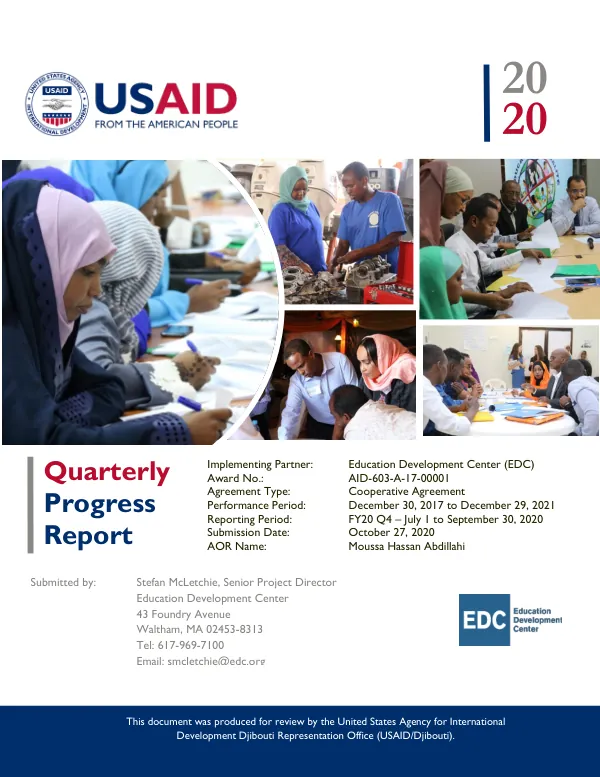
Quarterly Progress Report FY20 Quarter 3 – April 1 to June 30, 2020 Djibouti Workforce Development Program
Sign inCARDNO EMERGING MARKETS USA, LTD.
Quarterly Progress Report FY20 Quarter 3 – April 1 to June 30, 2020 Djibouti Workforce Development Program
The Djibouti Workforce Development Program began in December 2016 and concluded in December 2021.
2020 · 56 pages
Sign in to readA free account is required to download.
Abstract
The program aimed to improve the employability of Djibouti's workforce by enhancing vocational training, promoting sustainable linkages between TVET institutions and employment providers, and strengthening job placement, retention, and advancement services. The program was implemented by Education Development Center, with subcontractors Cardno Emerging Markets, SoukTel, and TakingITGlobal (TIG). The program focused on three main objectives: IR1, IR2, and IR3. IR1 aimed to expand quality vocational workforce readiness programs, while IR2 sought to establish sustainable, productive linkages between TVET institutions and employment providers. IR3 aimed to strengthen job placement, retention, and advancement services. The program's interventions included institutionalizing employability skills within the education system, improving technical or hard skills training, and providing career counseling services. Implementation of the program's objectives involved several key activities. Institutionalizing employability skills within the education system included developing a framework for integrating employability skills into the curriculum and providing training for teachers. Improving technical or hard skills training involved establishing partnerships with local organizations to provide training in areas such as electrical and mechanical trades. Career counseling services were provided to students and graduates to help them make informed decisions about their career paths. The program also focused on establishing sustainable, productive linkages between TVET institutions and employment providers. This involved conducting labor market analysis, organizing employment symposia, and strengthening public-private partnerships. The program also aimed to expand work-based learning opportunities and provide entrepreneurship training and accompaniment to graduates and out-of-school youth. Strengthening job placement, retention, and advancement services was another key objective of the program. This involved strengthening the institutional capacity of ANEFIP, establishing a job-matching platform, and providing gender and social inclusion training. The program also aimed to promote sustainability mechanisms, environmental compliance, and policy and governance support. The program's geographic coverage was limited to Djibouti, with a focus on improving the employability of the country's workforce. The program's reporting period spanned from October 2018 to September 2020, with quarterly progress reports submitted to USAID/Djibouti. Implementation challenges and lessons learned were also documented throughout the program. The program faced challenges related to the COVID-19 pandemic, which impacted work plan activities. However, the program's implementing partners and stakeholders worked together to adapt to these challenges and ensure the program's continued progress. The program's impact was evaluated through various monitoring and evaluation activities. Success stories and impact of the COVID-19 pandemic on work plan activities were documented in annexes to the quarterly progress reports. The program's financial report for FY20 Q3 was also included in the annexes. Overall, the Djibouti Workforce Development Program aimed to improve the employability of Djibouti's workforce by enhancing vocational training, promoting sustainable linkages between TVET institutions and employment providers, and strengthening job placement, retention, and advancement services. The program's implementation involved several key activities, including institutionalizing employability skills within the education system, improving technical or hard skills training, and providing career counseling services.