CENTER FOR EDUCATIONAL DEVELOPMENT
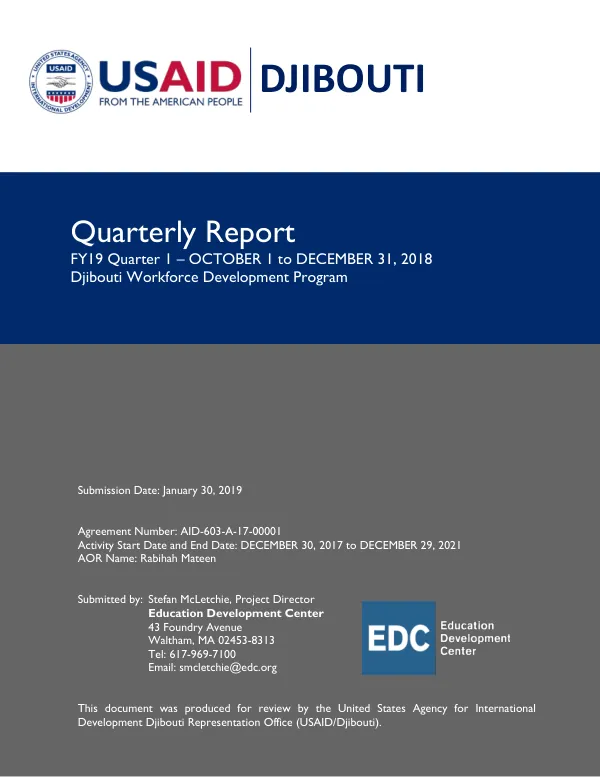
USAID/Djibouti Workforce Development Project FY19 Q1 Quarterly Report
The Djibouti Workforce Development Program is a five-year project initiated by the United States Agency for International Development (USAID) in December 2016.
2019 · 34 pages
Sign in to readA free account is required to download.
Abstract
The program aims to improve workforce readiness and competitiveness in Djibouti based on market needs. The project is executed by the Education Development Center, a global nonprofit organization that has implemented workforce development programs for USAID in several African countries. The program has three Sub-Intermediate Results (SIR): 1) Quality vocational workforce readiness programs expanded; 2) Sustainable, productive linkages between technical/vocational education institutions and employment providers developed; and, 3) Job placement, retention, and advancement services strengthened. The host-country partners include the Association Nationale de l'Emploi, de la Formation et de l'Insertion Professionnelle (ANEFIP), the Chambre de Commerce de Djibouti (CCD), and the Ministère de l'Education Nationale et la Formation Professionnelle (MENFOP). ANEFIP supports job seekers to improve their employability and entrepreneurship skills and find internships or employment or start their own businesses. CCD supports building public-private partnerships, training and supporting entrepreneurs, and training job seekers in the transportation and logistics sector. MENFOP manages the country's technical and vocational education and training institutions (TVETs), where students acquire basic technical skills for the job marketplace. The program includes a cross-cutting gender focus to raise awareness of gender laws and policies among partners and the private sector, and ensure young women are given equal access to technical and soft skills training and employment opportunities. However, due to conflicts between WFD and ANEFIP regarding funding rates for training and responsibility for job placement of participants, ANEFIP suspended activities with WFD in late May 2018, which continues through this reporting period. The program has several indicators to measure its progress, including the number of industry externships completed by TVET teachers, the number of public TVETs that have adopted training elements of Work Ready Now, Be Your Own Boss, and Work-based learning, and the number of individuals who complete USG-assisted workforce development programs. The program also aims to increase access to productive economic resources for female participants and improve their skills following completion of USG-assisted workforce development programs. As of the end of the reporting period, the program has achieved some results, including a 57% percentage of female participants in USG-assisted programs designed to increase access to productive economic resources. However, the program has not yet achieved its annual targets for the number of industry externships completed by TVET teachers, the number of public TVETs that have adopted training elements of Work Ready Now, Be Your Own Boss, and Work-based learning, and the number of individuals who complete USG-assisted workforce development programs.