USAID
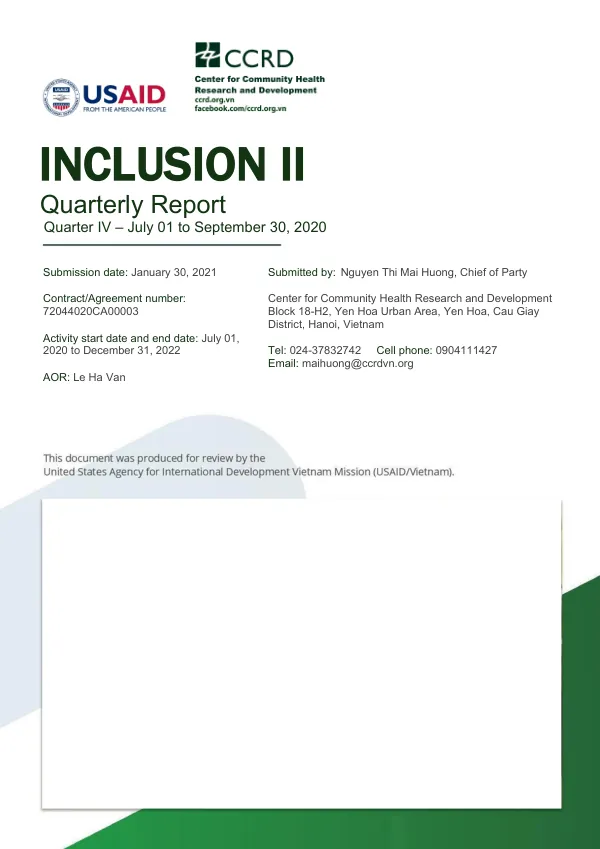
Quarterly Report: Inclusion II Project
The Inclusion II project, managed by the Center for Community Health Research and Development (CCRD), is part of the overall Inclusion Program supported by USAID.
2021 · 17 pages
Sign in to readA free account is required to download.
Abstract
The project aims to improve the quality of life of people with disabilities, particularly Agent Orange victims, in Kon Tum and Binh Dinh provinces. To achieve this goal, the project focuses on three main objectives: expanding rehabilitation services, expanding social services, and improving disability policies. The project's key interventions include strengthening rehabilitation facilities and systems at provincial and district levels, developing rehabilitation human resources, improving the quality of rehabilitation service delivery, providing social support and inclusion services for people with disabilities, and enhancing their participation in social and programming activities. Additionally, the project aims to develop an enabling social and policy environment for people with disabilities. During the first quarter of the project, CCRD focused on preparatory activities at both central and provincial levels. The project recruited four out of five key personnel, including the Chief of Party, Grant Manager, Financial Manager, and M&E Manager. These personnel have excellent experiences and backgrounds in their respective areas. However, the recruitment process for the Disability Technical Lead was unsuccessful due to a lack of suitable candidates. CCRD also recruited a team of two short-term consultants to assist in the development of methods and tools for assessment and conduct field assessments of provincial rehabilitation capacity during the baseline survey. The recruited consultants are high senior experts in the field of rehabilitation at the central level. Other positions, such as project officers, M&E officers, finance, and admin staff, were also filled. The recruitment process was compliant with CCRD's Human Resource Management Policy and USAID standards. The Terms of Reference (TOR) for each position were developed by the HR unit, and the recruitment board was established to include suitable personnel. The announcement of recruitment was delivered through various channels, including CCRD's website, Facebook fanpage, NGO resource center, and job websites. The project also developed and submitted a draft work plan and budget for the first 15-month period. The work plan listed goals, objectives, overall strategies, project interventions, activities, and timelines by project objectives and targets. A detailed budget, including budgets for potential sub-awardees, was also developed. Furthermore, CCRD developed and submitted a draft AMEL plan, which is an integral part of the overall work plan. The AMEL plan was developed after the AMELP clinic training led by Learns in August 2020. The plan outlines the project's monitoring, evaluation, and learning framework for the three-year implementation period. CCRD obtained provincial permission to implement project preparatory work in Kon Tum and Binh Dinh provinces. The permission affirmed the acceptance of provincial authorities to CCRD to implement preparatory activities. The project also developed a baseline assessment protocol and data collection tools, which were approved by USAID and the province. Field work planning for the baseline was developed in close consultation with the province. Overall, the Inclusion II project has made significant progress in its first quarter, laying a solid foundation for project implementation in the coming quarter.
Related documents