MICHIGAN STATE UNIVERSITY FOUNDATION
Quarterly Report: January - March 2011
The Philippine Sanitation Alliance (PSA) project, implemented by AECOM International Development, aims to improve sanitation facilities and services in the Philippines.
2011 · 9 pages
Sign in to readA free account is required to download.
Abstract
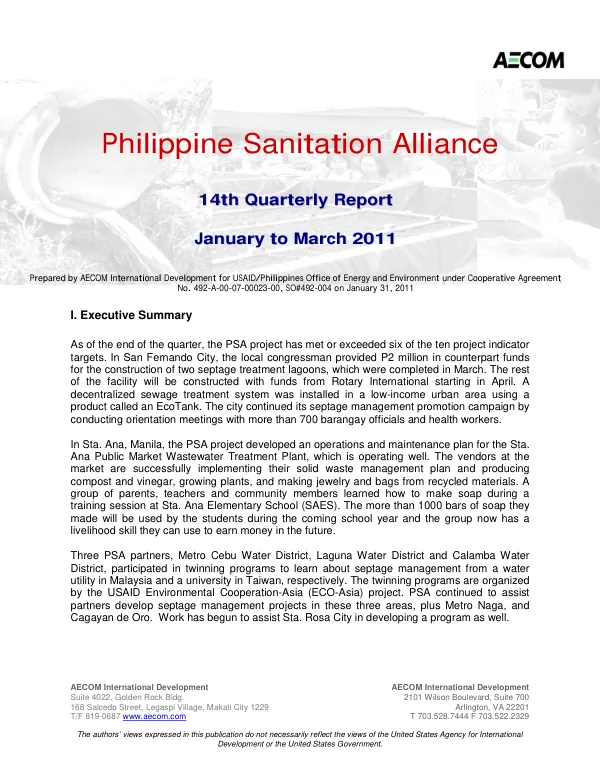
As of the end of quarter 14, the project has met or exceeded six of the ten project indicator targets. In San Fernando City, the local congressman provided P2 million in counterpart funds for the construction of two septage treatment lagoons, which were completed in March. A decentralized sewage treatment system was installed in a low-income urban area using an EcoTank product. The city continued its septage management promotion campaign by conducting orientation meetings with more than 700 barangay officials and health workers. In Sta. Ana, Manila, the PSA project developed an operations and maintenance plan for the Sta. Ana Public Market Wastewater Treatment Plant, which is operating well. The vendors at the market are successfully implementing their solid waste management plan and producing compost and vinegar, growing plants, and making jewelry and bags from recycled materials. A group of parents, teachers, and community members learned how to make soap during a training session at Sta. Ana Elementary School (SAES). The more than 1,000 bars of soap they made will be used by the students during the coming school year, and the group now has a livelihood skill they can use to earn money in the future. Three PSA partners, Metro Cebu Water District, Laguna Water District, and Calamba Water District, participated in twinning programs to learn about septage management from a water utility in Malaysia and a university in Taiwan, respectively. The twinning programs are organized by the USAID Environmental Cooperation-Asia (ECO-Asia) project. PSA continued to assist partners in developing septage management projects in these three areas, plus Metro Naga and Cagayan de Oro. Work has begun to assist Sta. Rosa City in developing a program as well. The project is on track to reach the intended results by September 30, 2011, as long as city and water district partners develop septage management projects per agreed-upon schedules. The PSA project has achieved significant results, including the development of an operations and maintenance plan for the Sta. Ana Public Market Wastewater Treatment Plant. Laboratory results from the El Nido Public Market Wastewater Treatment Plant and the Dumaguete City Septage Treatment Facility show that these facilities reduce pollution to levels that meet the government's effluent standards. The project has also trained people in environmental law, enforcement, public participation, and cleaner production policies, strategies, skills, and techniques. The project has exceeded targets in several areas, including the number of people trained in environmental law and enforcement, and the number of people trained in child health and nutrition. The project has also achieved significant progress in developing septage management programs, including the development of a septage management program with the Metro Cebu Water District and the signing of a partnership agreement with Malaysia's national wastewater operator, Indah Water Konsortium (IWK). The partnership aims to cooperate on developing and improving septage management programs, and the five water districts involved have developed and presented their respective collection plans, treatment design, and disposal plans and procedures. The project has also held a four-day training on natural systems for wastewater treatment, which yielded profiles of selected sites and conceptual facility designs using a natural system approach. PSA staff have been working with Calamba Water District to facilitate Calamba City's purchase of land for the septage treatment facility, as well as land for the sewage treatment facility planned for the Bucal spring area. In this regard, Lisa Lumbao made a presentation to the Calamba Water District Board on January 19, 2011. The project has also assisted the Naga Water District in deliberating on a site for the treatment facility. The PSA project has made significant progress in improving sanitation facilities and services in the Philippines, and has exceeded targets in several areas. The project continues to work with city and water district partners to develop septage management projects and improve sanitation services. The project's achievements demonstrate its commitment to improving sanitation and reducing pollution in the Philippines.