DEPARTMENT OF HEALTH
Quarterly Report: Philippine Sanitation Alliance
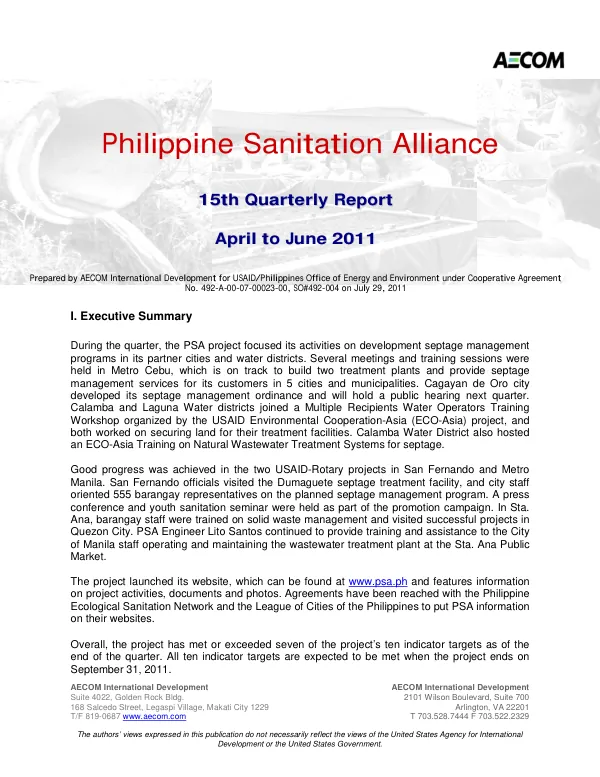
The Philippine Sanitation Alliance (PSA) project, implemented by AECOM International Development, focused its activities on development septage management programs in its partner cities and water districts during the quarter.
2011 · 10 pages
Sign in to readA free account is required to download.
Abstract
Meetings and training sessions were held in Metro Cebu, which is on track to build two treatment plants and provide septage management services for its customers in 5 cities and municipalities. Cagayan de Oro city developed its septage management ordinance and will hold a public hearing next quarter. Calamba and Laguna Water districts joined a Multiple Recipients Water Operators Training Workshop organized by the USAID Environmental Cooperation-Asia (ECO-Asia) project, and both worked on securing land for their treatment facilities. Calamba Water District also hosted an ECO-Asia Training on Natural Wastewater Treatment Systems for septage. Good progress was achieved in the two USAID-Rotary projects in San Fernando and Metro Manila. San Fernando officials visited the Dumaguete septage treatment facility, and city staff oriented 555 barangay representatives on the planned septage management program. A press conference and youth sanitation seminar were held as part of the promotion campaign. In Sta. Ana, barangay staff were trained on solid waste management and visited successful projects in Quezon City. PSA Engineer Lito Santos continued to provide training and assistance to the City of Manila staff operating and maintaining the wastewater treatment plant at the Sta. Ana Public Market. The project launched its website, which features information on project activities, documents, and photos. Agreements have been reached with the Philippine Ecological Sanitation Network and the League of Cities of the Philippines to put PSA information on their websites. Overall, the project has met or exceeded seven of the project's ten indicator targets as of the end of the quarter. All ten indicator targets are expected to be met when the project ends on September 31, 2011. The project is on track to reach the intended results by September 30, 2011, as long as city and water district partners develop septage management projects per agreed-upon schedules. This is needed to meet indicator number 1. Of the ten project indicators, AECOM has met or exceeded seven of them as of the end of quarter 15 (July 29, 2011). The project has made significant progress in training people in environmental law, enforcement, public participation, and cleaner production policies, strategies, skills, and techniques. A total of 59 people were trained in quarter 15, bringing the cumulative total to 2,692. The PSA conducted a training of trainers on May 30 and 31, preparing selected academe and community leaders to promote septage management at the barangay level. The training was held in partnership with the Metro Cebu Water District and the local governments of Lapu-Lapu City and Cebu City. A total of 107 people were trained. The Metro Cebu Water District made progress in developing its septage management program with assistance from the PSA and Philippine Water Revolving Fund-Support Program during the quarter. Several meetings were held with local government officials of Cebu, Cordova, and Lapu-Lapu. The Cagayan de Oro City Council is set to pass an ordinance that will require all residential and commercial building owners to desludge their septic tanks regularly. The septage management program, targeting to benefit about 650,000 people, is being developed in collaboration with the city's water district and Philippine Sanitation Alliance. Calamba and Laguna Water Districts attended training workshops held in Baliwag, Bulacan, and Cabanatuan City, respectively. The workshops are part of a series of trainings that aim to guide the participants to select appropriate technologies, design and review collection systems, and operate and maintain treatment facilities.