FHI 360
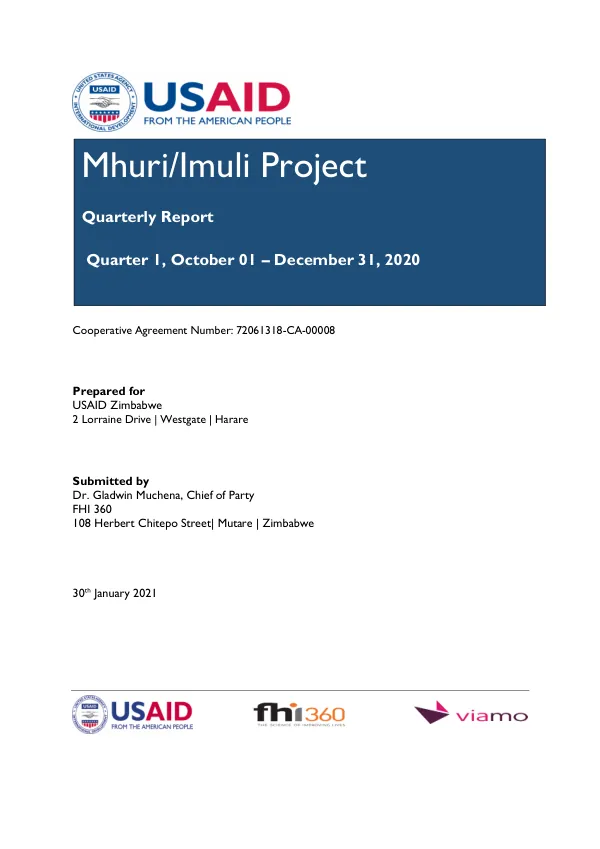
Quarterly Report: Mhuri/Imuli Project, Quarter 1, October 01 – December 31, 2020
Mhuri/Imuli is a five-year USAID-funded project aimed at improving maternal, newborn, and child health (MNCH) and family planning (FP) services in Zimbabwe.
2021 · 48 pages
Sign in to readA free account is required to download.
Abstract
The project is implemented by FHI 360 and focuses on seven districts in Manicaland Province and eight provinces nationwide, excluding Matabeleland South and Mashonaland Central provinces. The project's primary objective is to increase the availability of quality MNCH-FP services in the target areas. To achieve this, the project has implemented several interventions, including on-the-job training (OJT) for health care workers (HCWs), maternal and perinatal audit meetings, and quality assurance visits for family planning (FP) services. During the first quarter of its fourth year, from October 1 to December 31, 2020, the project made significant progress despite budget limitations. A total of 250 HCWs from 19 USG-supported facilities were trained in at least one complete module through OJT. Additionally, 18 district maternal and perinatal audit meetings were supported, with all 71 USG-supported facilities participating in at least one meeting. The project also reported notable achievements in the area of FP services. A family planning quality assurance visit was conducted with all FP partners in Masvingo, and IEC material was developed to promote FP services during the COVID-19 pandemic. Furthermore, meetings were held with Health Center Committee (HCC) members in Buhera District to address delays faced by pregnant women in accessing care. Through the project's support to the Ministry of Health and Child Care (MOHCC), several key indicators were achieved in Q1 FY21. These include a 19% increase in pregnant women booking for their first ANC visit before 12 weeks, 8,804 live births, and 8,996 institutional deliveries. The project also reported high coverage of uterotonics provided to women in the third stage of labor, resuscitation of newborns delivered in health facilities not breathing at birth, and initiation of low-birth-weight babies on Kangaroo Mother Care (KMC). The project's progress was also reflected in the area of malaria control. A total of 140 Village Health Workers (VHWs) in Chimanimani, Chipinge, and Mutare districts received malaria community case management (MCCM) training, integrated with COVID-19 and gender awareness. Overall, the Mhuri/Imuli project has made significant progress in improving MNCH-FP services in Zimbabwe, despite the challenges posed by the COVID-19 pandemic. The project's achievements demonstrate its commitment to improving the health outcomes of mothers, newborns, and children in the target areas.