CNFA, INC.
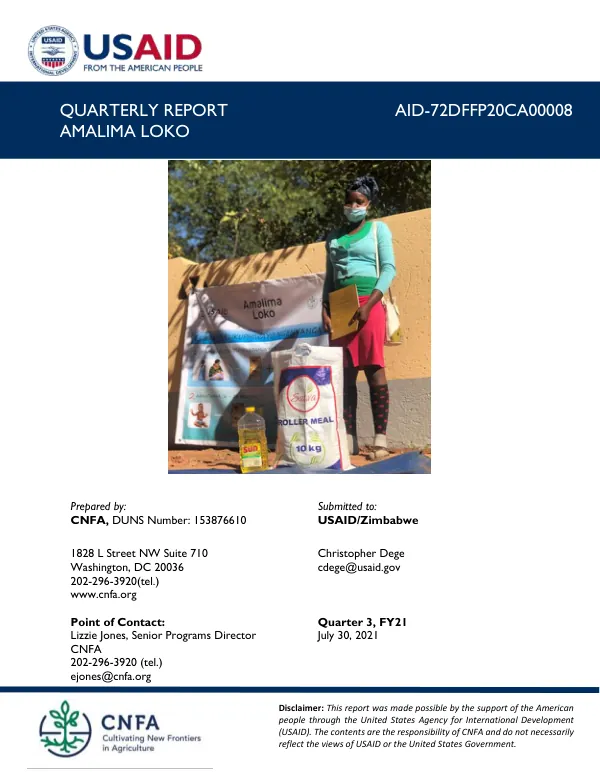
Quarterly Report: Amalima Loko Program, Q3 FY21
The Amalima Loko program is a 5-year Resilience Food Security Activity implemented by CNFA in collaboration with the Organization of Rural Associations for Progress (ORAP), Dabane, Mercy Corps, International Medical Corps (IMC), and The Manoff Group.
2021 · 15 pages
Sign in to readA free account is required to download.
Abstract
The program aims to improve food and nutrition security for over 67,000 vulnerable households in rural Zimbabwe through increased food access and sustainable watershed management. The program is currently operating in 40 wards across Tsholotsho, Nkayi, Lupane, Binga, and Hwange districts of Matabeleland North province, with plans to expand to 87 wards in year 2. The program's third quarter report for FY21 highlights progress on the Year 1 workplan, including the operational roll-out, M&E system design, developing the FY22 PREP, continuing the Refine and Implement (R&I) process, household registration, and launching the Blanket Supplementary Feeding Program (BSFP). Despite the challenges posed by the COVID-19 pandemic, the project has made significant progress, protecting the health and safety of staff through remote work and limiting travel and staff presence in offices. The program has also made notable achievements in technical activities, including the finalization and approval of the R&I/Year 1 workplan, the launch of the BSFP, and the development of M&E tools and deliverables. The team has also participated in numerous trainings and workshops, prepared tools and resources for upcoming interventions, and collected data for the program's first R&I studies. Community Visioning (CV) is a foundational component of the Amalima Loko program, and staff launched the CV process in Q3. The CV Technical Coordinator and Field Officers participated in the World Food Program (WFP) Community Based Participatory Planning training and engaged with NGOs operating in Matebeleland North to learn from their experience and coordinate strategies for the CV approach. The program conducted district and ward-level engagement sessions with stakeholders to introduce CV and its objectives, process, and roles and responsibilities. Watershed management is another key component of the program, and the team met with stakeholders in all five districts to introduce the watershed approach. Government stakeholders expressed keen interest in working with Amalima Loko to improve the management of the Gwayi catchment, and the team organized multi-stakeholder WCSCs to oversee watershed management at the cluster and micro-catchment level. The initial WCSC was held in Hwange, and the team highlighted Amalima Loko's watershed management approach, including improved community ownership and governance, community implementation of plans, and the use of Geographic Information System (GIS) for decision-making. The program has also made progress in watershed cluster mapping, identifying villages in relation to their micro-catchments and important watershed assets, and labeling river names and village boundaries. The meetings were used to review and discuss the watershed management approach, and participants were accepting of the cluster approach and keen to support the process. The Amalima Loko program has made significant progress in its third quarter, despite the challenges posed by the COVID-19 pandemic. The program's focus on community visioning and watershed management has shown promising results, and the team is working to build on these achievements in the coming quarters. The program's commitment to improving food and nutrition security for vulnerable households in rural Zimbabwe remains a top priority, and the team is working tirelessly to achieve this goal.
Related documents