USAID
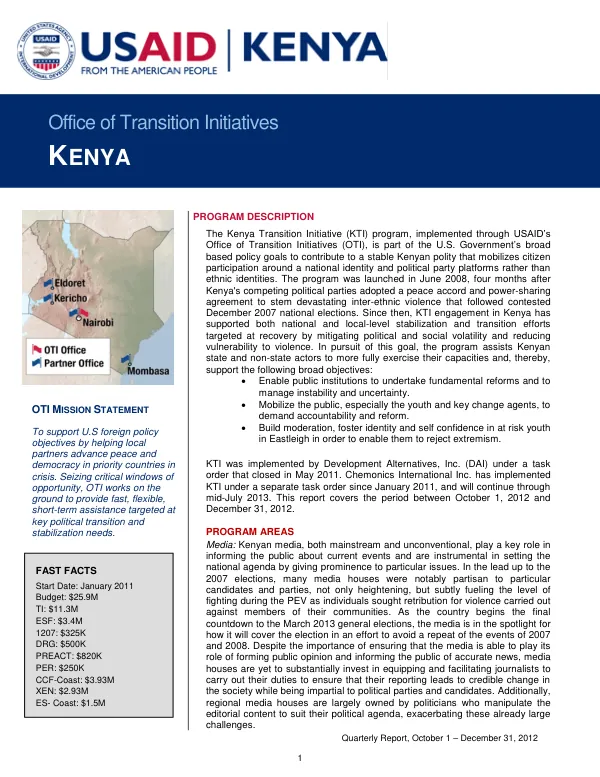
Quarterly Report, October 1, 2013 – December 31, 2013
The Kenya Transition Initiative (KTI) expanded its objectives in May 2011 to include a counter extremism component in the Nairobi suburb of Eastleigh.
2013 · 6 pages
Sign in to readA free account is required to download.
Abstract
Eastleigh has a large population of Somali immigrants, predominantly composed of youth, who are vulnerable to extremist ideologies due to systemic marginalization, limited access to higher education, inadequate employment, crime, and corruption. The KTI-Eastleigh project (KTI-E) aims to encourage moderation and foster identity and self-confidence in at-risk youth to enable them to reject the recruitment efforts of extremist groups. To achieve this objective, KTI-E works with locally-based organizations and the Eastleigh community at large to respond to risk factors through a three-pronged approach: increasing the propensity among youth for moderation and non-violence, empowering local youth, and improving livelihoods for youth. Since its inception in July 2011, KTI-E has funded 101 activities, totaling $3,671,926. During the reporting period, a total of 13 activities totaling $676,165 were cleared. One of the key initiatives supported by KTI-E is the Building Partnerships in Kamukunji project, which aims to promote constructive dialogue between the Constituency Office, the Eastleigh Business District (EBDA), the Eastleigh Residents Association (ERA), and the community. KTI provided equipment to the Constituency Office to enhance its operational capacity and carried out awareness forums in the Kamukunji area to promote partnerships and reduce inclinations towards combative methods of solving conflict. Another initiative supported by KTI-E is the Support to Liberty Center project, which aims to provide a common space for at-risk youth to meet and engage in social, cultural, and recreational activities. KTI is currently supporting the center to develop its facilities, including refurbishing the auditorium and providing studio equipment for events. This initiative aims to reduce the likelihood of youth being targeted by extremist recruiters. The Youth Engagement through Movies initiative, developed by the Youth Arts Development and Entrepreneurship Network (YADEN) in partnership with KTI, serves as a foundation for artistic engagement to improve youth participation. KTI partnered with YADEN to replicate a series of innovative and creative visual arts that convey messages on issues pertaining to tolerance and extremism. The initiative aims to reduce stigma associated with extremist ideologies within the community. The KTI-E program has undergone several evaluations and studies to provide input to the program team on how to improve its implementation and provide information for designing future USAID countering violent extremism (CVE) programs. A final qualitative study and a quantitative survey of the program were commissioned to review and consolidate all the data, information, and studies generated by KTI's CVE activities. The study aims to share this information with select interested parties. The KTI-E program has made significant progress in achieving its objectives, including enhancing advocacy capacity and sustained positive dialogue with the Government of Kenya (GOK), improving communication channels for youth, and increasing access to community, recreational, and cultural activities. The program has also improved leadership capacity among youth, networking among youth organizations, and access to counseling and mentoring services.
Related documents