DAI
Africa Lead FY 2018 Quarter 1 Public Report
Africa Lead is a program that supports the advancement of agricultural transformation in Africa as proposed by the Comprehensive Africa Agriculture Development Programme (CAADP).
2018 · 52 pages
Sign in to readA free account is required to download.
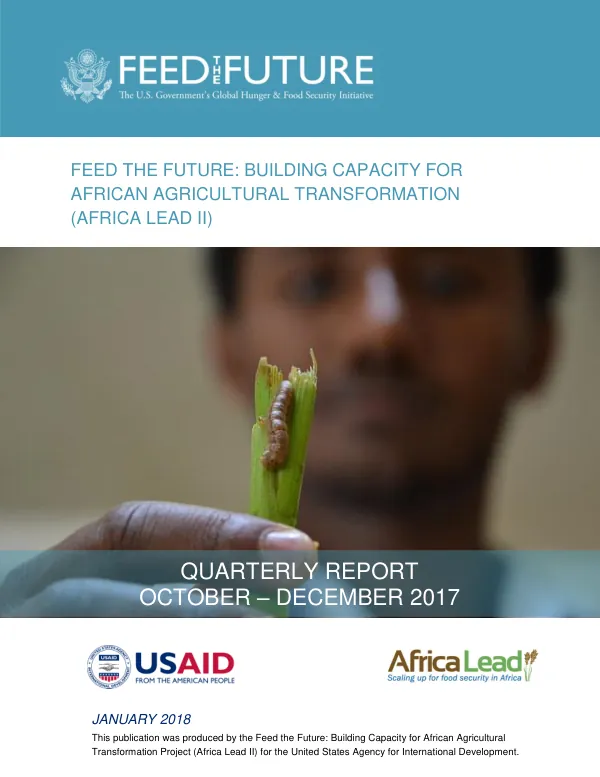
Abstract
The program contributes to the Feed the Future goals of reduced hunger and poverty by building the capacity of champions and institutions in agriculture to develop, lead, and manage policies, structures, and systems needed for transformation. The Bureau for Food Security at the U.S. Agency for International Development has established three priority areas of agriculture change: (1) changes in policies themselves, (2) changes in systems to formulate and implement policy changes, and (3) laying the foundations for the next generation of change. Africa Lead promotes changes in systems to formulate and implement policy changes by focusing on building capacity and strengthening individuals, institutions, and networks. The program concentrates on four key areas: (1) evidence-based planning, (2) mutual accountability, (3) coordination and inclusiveness, and (4) policy plans and institutions. Africa Lead provides support, facilitation, and training to partners to improve institutional capacity and broader systems and architecture to promote agricultural transformation. The program also promotes the effective and inclusive participation of non-state actors in policy processes and continues to build a process by which evidence can play a greater role in determining directions and programs in agriculture. Africa Lead is a flexible mechanism to support USAID initiatives at the mission and continental level. The program is truly greater than the sum of its parts, and its full impact can be appreciated by viewing individual activities within the context of the continent-wide goals that drive them. The program's activities are demand-driven, and it serves as a flexible mechanism to support various initiatives. The report covers the major accomplishments and outputs from October to December 2017, which is Quarter 1 of Africa Lead's fifth year of implementation. The program's activities are summarized in three cluster areas: capacity development, policy support, and knowledge sharing. The report includes dashboards for each of the project's buy-ins, providing a snapshot view of activities and performance indicators for each. Capacity building is a key component of Africa Lead, and the program has made significant progress in this area. The program has provided training and support to over 2,500 farmers, and has established 15 demonstration plots to demonstrate the effectiveness of sustainable agriculture practices. The program has also established a network of champions and institutions to promote agricultural transformation. The program has also made significant progress in policy support, providing support to governments and institutions to develop and implement policies and programs. The program has also promoted the effective and inclusive participation of non-state actors in policy processes. The program has also built a process by which evidence can play a greater role in determining directions and programs in agriculture. In the area of knowledge sharing, the program has promoted the sharing of best practices and knowledge among stakeholders. The program has also established a network of experts and institutions to share knowledge and expertise. The program has also promoted the use of evidence-based planning and mutual accountability to inform policy and program development. The program has also made significant progress in its mission dashboards, providing a snapshot view of activities and performance indicators for each of the project's buy-ins. The dashboards provide a clear picture of the program's progress and achievements, and will be used to inform future programming and decision-making. Overall, Africa Lead has made significant progress in its first quarter of implementation, and has established a strong foundation for future success. The program's activities are demand-driven, and it serves as a flexible mechanism to support various initiatives. The program's full impact can be appreciated by viewing individual activities within the context of the continent-wide goals that drive them.
Related documents
Documents in this collection
 2013
2013USAID DEC
Africa Leadership Training and Capacity Building Program: Quarterly Report for October - December 2012 (Ninth Quarter of Project Implementation)
Open record 2014
2014USAID DEC
Feed the Future: Building Capacity for African Agricultural Transformation (Africa Lead II) Quarterly Report: April-June 2014
Open record