FHI 360
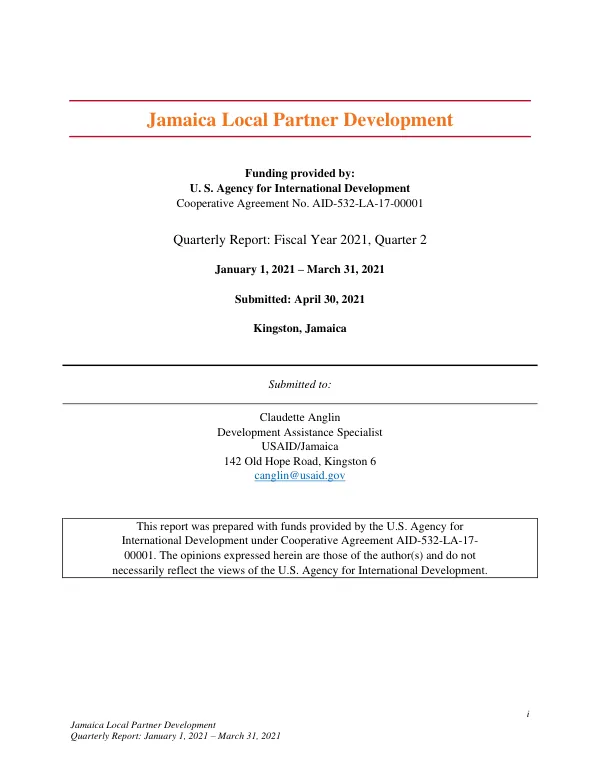
Quarterly Report: October 1, 2020 – December 31, 2020
The activity description outlines the six-year Local Partner Development (LPD) program, funded by USAID through the Caribbean Basin Security Initiative (CBSI).
2021 · 50 pages
Sign in to readA free account is required to download.
Abstract
The program aims to strengthen Jamaican institutions in advancing collaborative, evidence-based youth crime and violence prevention strategies. LPD's realigned vision of success is that Jamaican institutions will become more effective in this area, and that Civil Society Organizations (CSOs) and key public and private partners will be better able to mobilize and sustain targeted and effective secondary and tertiary prevention. The program consists of three components: Component 1: Strengthening Targeted CSOs to Implement Secondary and Tertiary Crime and Violence Prevention Strategies; Component 2: Building Private Sector Partnerships for Crime Prevention; and Component 3: Strengthening the Capacity of Key Government of Jamaica (GOJ) Ministries, Departments and Agencies (MDAs) to Implement and Sustain Effective Secondary and Tertiary Crime Prevention Initiatives. Component 1 activities will strengthen the efforts of CSOs that work on crime and violence prevention, allowing them to become more effective actors. These CSOs will be able to provide sustainable services that positively impact crime and violence in Jamaica. Crime prevention efforts involving civil society and key stakeholders have greater legitimacy and confidence. Component 2 activities will build the capacity of private sector partnerships to effectively support secondary and tertiary youth crime prevention. The sector will be involved in strategic efforts to prevent and reduce youth crime and violence. Component 3 activities will engage GOJ institutions to design and sustain effective crime prevention strategies. The capacity of GOJ MDAs will be increased to implement evidence-based secondary and tertiary crime prevention strategies. The program's intermediate results include: * Intermediate Result 1.1: CSOs better equipped to target at-risk youth and deliver secondary and tertiary prevention programs. * Intermediate Result 2.1: Private sector partnerships formed with civil society and government to implement secondary and tertiary crime and violence prevention initiatives. * Intermediate Result 3.1: Increased capacity of government MDAs to implement evidence-based secondary and tertiary crime prevention strategies. The program's quarterly report for October 1, 2020 – December 31, 2020, highlights key achievements and progress made during the reporting period. The report includes information on activity implementation, progress, and challenges faced by the program. The report also provides an update on the Performance Monitoring and Evaluation Plan (PMEP) and the financial management of the program. The PMEP is a critical component of the program's monitoring and evaluation framework, which ensures that the program's progress is tracked and reported on a regular basis. The report highlights the importance of building partnerships between civil society, government, and private sector organizations to prevent and reduce youth crime and violence. The program's focus on evidence-based approaches to crime prevention is also emphasized, as well as the need to strengthen the capacity of GOJ institutions to design and sustain effective crime prevention strategies. The report concludes by highlighting the program's commitment to transparency and accountability, and its efforts to ensure that the program's activities are aligned with the needs and priorities of the Jamaican people.