DEVIDA
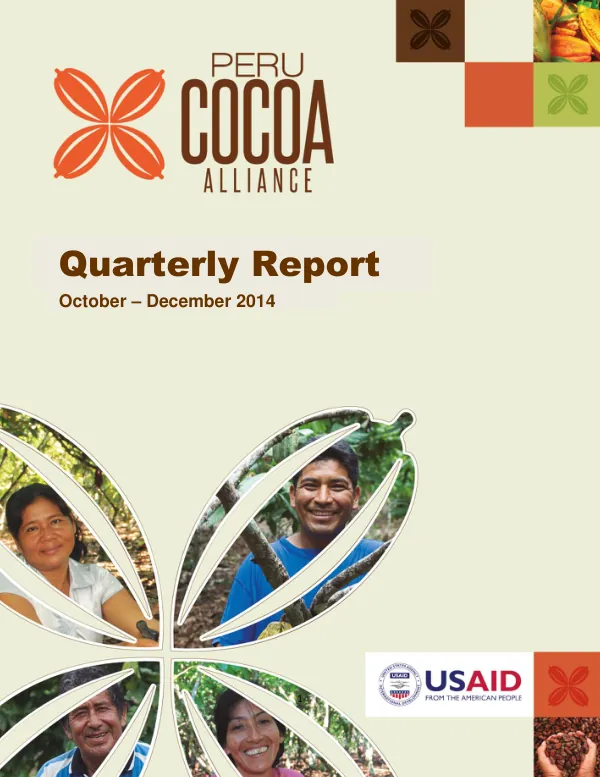
Quarterly Report | October – December, 2014
The Peru Cocoa Alliance has been designed to consolidate the fifteen years of support USAID has granted the Peruvian Government to grow cocoa in the regions of San Martin, Ucayali and Huanuco, and take these areas towards legal production and sustainable development.
2014 · 39 pages
Sign in to readA free account is required to download.
Abstract
In all three regions, cocoa has become the first economic vehicle to bring legality and development to thousands of families. During the October-December 2014 quarter, the region of San Martin became the first cocoa producer in the country, installing, with the Alliance, 4,564 hectares, while Huanuco and Ucayali installed 4,972 ha and 3,913 ha, respectively. The Alliance has faced several challenges regarding new alliances with actors engaged in cocoa cultivation and communities of interest. Due to the political context of elections, the Alliance focused its efforts on continuing to consolidate Memoranda of Understanding (MoU) with Regional and local Governments, and on promoting cocoa cultivation under agroforestry systems (AFS). Moreover, this quarter saw new alliances between stakeholders and private institutions in the region of San Martin, who committed to expanding and installing fine flavor cocoa under AFS. A total of 13,456 cocoa hectares were installed during the October-December 2014 period, representing 48.03% of the global committed goal. As of December, 17,656 families have been reported to benefit from the cocoa and plantain value chains. Financial institutions or investment funds placed US$ 20,226,259 during the quarter, and 4,434 families associated with the Alliance have had access to financial services. Finally, US$ 27,356,489 were leveraged from the private sector and US$ 2,348,542 were leveraged from the Peruvian Government. The communications and gender components implemented activities according to the technical demands of the other areas. Such activities included specific campaigns pursuant to the cocoa agricultural calendar. Moreover, Communications continued implementing the Strategy approved by USAID, with the objective consolidating the Alliance's position as a leader in fine flavor cocoa. Furthermore, in October, the Alliance was visited by a USAID delegation from Washington as well as the U.S. Ambassador to Peru Brian Nichols, who congratulated the Alliance on its progress and on the impact it and USAID has made on Alternative Development. In October 2014, the DEVIDA Promotion and Monitoring Office performed an on-site verification of goals with the purpose of verifying whether USAID operators were reaching their goals. A representative sample of 271 Alliance partner producers was evaluated across 418 communities in the regions of San Martin, Ucayali and Huanuco. Based on the results obtained from the verification, DEVIDA reported the existence of 97% of the farmers verified. Moreover, with regard to the areas of installed cocoa reported to DEVIDA, there was 87% progress made. These figures match the results obtained by the Monitoring and Evaluation Area of the Alliance. Producers have a favorable opinion with respect to the field work performed by the Alliance and the results obtained have given input that have been incorporated into the 2015 work strategies. The Alliance will continue to consolidate strategies seeking private investment and developing mechanisms through which markets can help expand and make sustainable the installation of cocoa hectares, based on cocoa-economies in all three regions. This way, it will allow for the competitive marketing, financing and technical assistance services needed to capitalize the small-scale production of producers, partners to the Alliance. In the region of San Martin, buyers partners to the Alliance stored a total of 1,653.2 tons of dried cocoa beans. A total of 380 thousand Bellaco Hartón and Bellaco plantain were sold to Inca Krops, at an average selling price of S/. 0.20. Moreover, a total of 25,000 bunches were sold on the domestic market, at a selling price of S/. 2.0/bunch. The purchase agreement executed with Inka Crops is being fulfilled, seeing the delivery of 30,000 fingers/week (120,000 fingers/month) of Bellaco plantain and Banana produced by organizations in the region of Ucayali who are complying with the quality standards proposed by the company. In the region of San Martin, 3,224 hectares of cocoa were expanded under agroforestry systems. This quarter, 74% of the goals have been achieved. The remaining percentage will be completed in the following quarter (January-March 2015). Georeferencing of 3,120 hectares of installed cocoa was completed, thus reaching a total of 5,317 georeferenced hectares representing 23% of the 23 thousand hectares set as the goal. Installation of 6,092 hectares of temporary shade (plantain, pigeon peas or a combination of both) was completed to ensure the cultivation of cocoa to be installed between January and May 2015. In the region of San Martin, 135 forest species seedlings were planted in over 1,071 hectares of cocoa.