AIDER
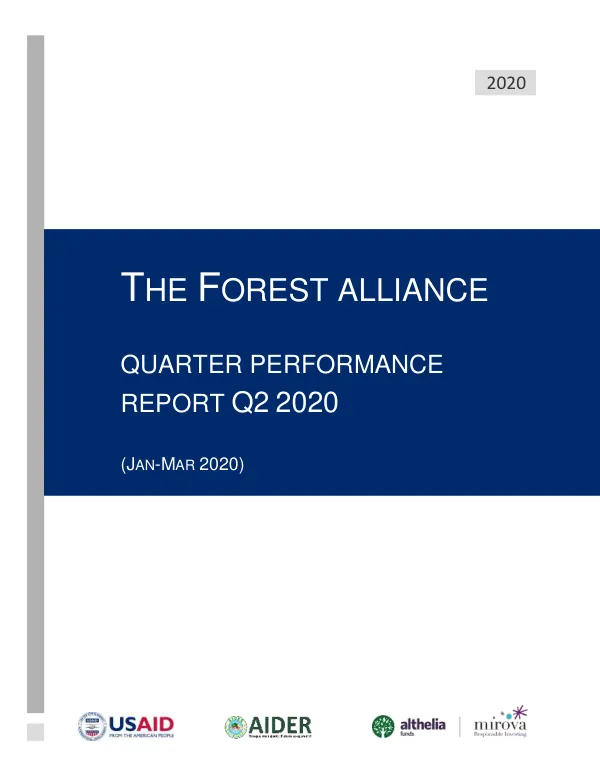
The Forest Alliance Quarter Performance Report Q2 2020
The Forest Alliance: Sustainable Business for Community Forest Management in Ucayali is a program initiated in April 2019, with the goal of conserving and sustainably managing forests in indigenous communities' lands.
2020 · 108 pages
Sign in to readA free account is required to download.
Abstract
The program aims to restore degraded lands, scale up an innovative community forest management (CFM) model, and contribute to lower greenhouse gas emissions and the welfare of indigenous peoples in the Peruvian Amazon. The direct beneficiaries of the program are seven indigenous communities located in the Ucayali region. The program's purpose is to strengthen enabling conditions for CFM in Ucayali, improve the livelihoods of indigenous communities through the creation and strengthening of sustainable forest businesses, and transfer the CFM model to key stakeholders. To achieve the first result, the Forest Alliance is supporting three enabling conditions prioritized for CFM in the seven communities: control and monitoring of lands, capacities for deforestation monitoring, and public sector support. The seven community forest monitoring and control committees continue to patrol their territories and report to their respective Community Assemblies. During the first quarter of 2020, the committees carried out a total of 10 patrols and began using early deforestation alerts, which have two types of sources: community key informants and a near real-time deforestation monitoring system developed by the AIDER technical team. The annual Forest Stewardship Council (FSC) certification audit confirmed that the communities of Calleria and Roya comply with national FSC standards, and their certificate has been extended until July 2021. The program continues to support the seven communities to formalize their communal territorial limits and secure property titles. Meetings were held with the Regional Directorate of Agriculture of Ucayali (DRAU) to follow up on the activities of reviewing reports and scheduling field inspections, however, the activities are delayed due to changes in key personnel and the lack of technical personnel to complete the georeferencing work. The Forest Alliance also supports the community authorities in following up on complaints lodged earlier in the Special Prosecutor's Office for the Environment (FEMA) for environmental crimes of illegal logging and deforestation. The program has communicated with the USAID-funded Institutional Strengthening Project of DEVIDA to assess options for working together on the problem of illicit crops in the partner communities of the Forest Alliance. The program's progress is measured through a set of indicators outlined in the Monitoring, Evaluation, and Learning (MEL) plan. The indicators include the number of community forest monitoring and control committees established, the number of patrols conducted, and the number of communities that have formalized their communal territorial limits and secured property titles. The Forest Alliance has made significant progress in the first quarter of 2020, with the seven community forest monitoring and control committees continuing to patrol their territories and report to their respective Community Assemblies. The program has also made progress in enhancing capacities for deforestation monitoring and supporting the community authorities in following up on complaints lodged earlier in the Special Prosecutor's Office for the Environment (FEMA). The program's next steps include continuing to support the seven communities to formalize their communal territorial limits and secure property titles, and working with the USAID-funded Institutional Strengthening Project of DEVIDA to address the problem of illicit crops in the partner communities of the Forest Alliance. The program will also continue to monitor and evaluate its progress through the set of indicators outlined in the MEL plan. The Forest Alliance's progress is also reflected in the improvement of the livelihoods of indigenous communities through the creation and strengthening of sustainable forest businesses. The program has supported the development of non-timber forest products' (NTFP) from indigenous forests, inserted in sustainable value chains, and the forests in indigenous communities sustainably used for timber production. The program has also supported the restoration of degraded indigenous lands through forest plantations and agroforestry. The Forest Alliance's progress is also reflected in the transfer of the CFM model to key stakeholders. The program has developed and implemented a learning program on CFM, which has been developed and implemented by indigenous organizations and authorities and other key stakeholders to promote the scale-up of the model. The program has also consolidated and under operation existing CFM platforms in partnership with government and civil society. Overall, the Forest Alliance has made significant progress in the first quarter of 2020, with the seven community forest monitoring and control committees continuing to patrol their territories and report to their respective Community Assemblies. The program has also made progress in enhancing capacities for deforestation monitoring and supporting the community authorities in following up on complaints lodged earlier in the Special Prosecutor's Office for the Environment (FEMA). The program's next steps include continuing to support the seven communities to formalize their communal territorial limits and secure property titles, and working with the USAID-funded Institutional Strengthening Project of DEVIDA to address the problem of illicit crops in the partner communities of the Forest Alliance.
Related documents