USAID DEC
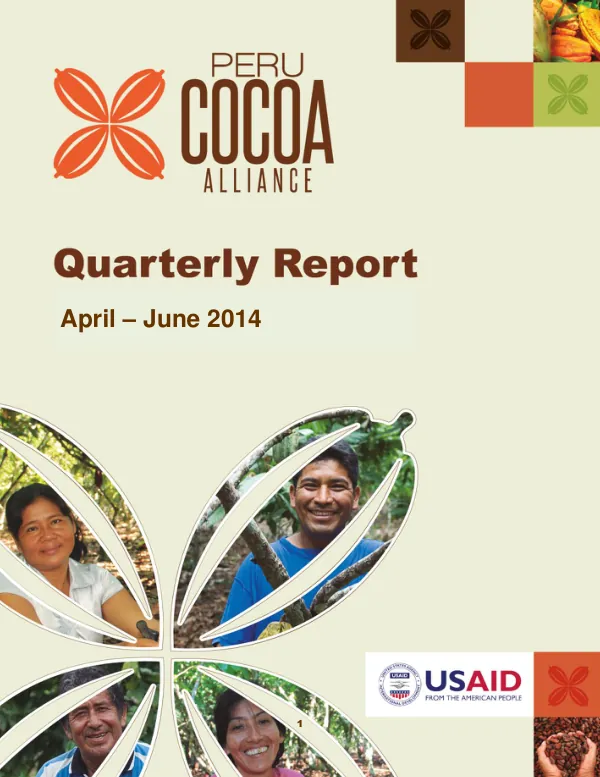
Quarterly Report: April – June, 2014
The Peru Cocoa Alliance's purpose is to consolidate investments made by USAID and the Peruvian Government in the coca-growing areas of San Martin, Ucayali, and Huanuco to achieve legality and sustainable development.
2014 · 38 pages
Sign in to readA free account is required to download.
Abstract
In these areas, cocoa has become the primary economic vehicle towards legality and development for thousands of families. Great progress has been made in the Region of San Martin, which has become the largest cocoa production region in the country, with over 40,000 hectares planted and almost 30,000 producers engaged in this activity. Despite this progress, there is still a lot left to do in these regions. The average number of cocoa in production is 1.7 hectares per family, which means income barely surpasses the poverty line. Only 35% of producers sell their products to a Cooperative or exporting company, while the majority gives their products to informal intermediaries, losing both revenue and product quality. Moreover, only 30% have access to some kind of formal financing. There is no long-term funding to help expand new areas of cocoa, and only a few producers have access to quality technical assistance. To address these challenges, the Alliance provides access to marketing, financing, and technical assistance services necessary to provide capital to small producers and help them grow. The Alliance has made significant progress in the last quarter, expanding new cocoa areas and attracting private investors along the entire cocoa value chain. A total of 1,747 ha of cocoa patterns were planted in the April-June quarter, reaching a total of 8,303 ha of installed cocoa patterns at the end of June. Another 3,360 ha of cocoa are growing in nurseries to be transferred to the field in the upcoming weeks. The Alliance has also begun an aggressive grafting process campaign to transform these cocoa crops into fine flavor cocoa. A great achievement was the acquisition of a stick production system for the Junajui area, intervening almost 80 ha of producers that have the type of cocoa required for fine flavor arrangements. Each day, around 26,000 sticks of six different clonal arrangements are cut, packaged, labeled, and delivered to the different regional offices, allowing the Alliance to graft 60 ha per day. Significant progress has been made in the field, enabling the Alliance to provide capital to thousands of small cocoa producers. This has been possible thanks to the project's great budgetary efforts, which cannot be maintained indefinitely, thus driving the need to generate income within a global project sustainability strategy. To this end, the Alliance needs to continue its leverage policy and attract private investment, such as venture capital funds, which will be mentioned in more detail below. The Alliance has made significant progress in attracting private investment for the cocoa economy in Peru. Three venture capital funds have voiced their interest in investing in the cocoa sector, and what is more, they are interested in investing and partnering with small- and medium-sized producers. The challenge is to develop a model that will provide them a safe environment and guarantee the success of their investment. The Alliance met with the Althelia Fund on June 3, the ACUMEN fund on May 23, and the Agroforestal Moringa Fund on July 4, making the most progress with the latter. The Peru Cocoa Alliance has also made progress in improving the cocoa bean collection levels of small producers. Buyers partnering with the Alliance have collected 2,435 tons of cocoa beans from 8 organizations, as detailed below. Major chocolate companies such as the Lindt Cocoa Foundation visited Alliance work areas with Armajaro, showing interest in the fine flavor cocoa business. A total of 238,128,000 plantains were sold to INKA CROPS between May and June, an average of 23,812,000 per delivery. The average sale price was S/0.20 per unit. The Alliance has also identified the main bottlenecks for the trade coordination of Baby Banana or Moquisho, as well as commitments made by the Alliance with Redesing Peru (Representative of Altromercato in Peru) and PROMPERU. The Alliance continues to work on developing a model that will provide a safe environment and guarantee the success of investment for private investors.
Related documents