MANAGEMENT SYSTEMS INTERNATIONAL
Quarterly Report, October-December 2016: USAID/Mexico Promoting Justice Project
The USAID/Mexico Promoting Justice Project (PROJUST) is implementing activities under its third work plan.
2016 · 50 pages
Sign in to readA free account is required to download.
Abstract
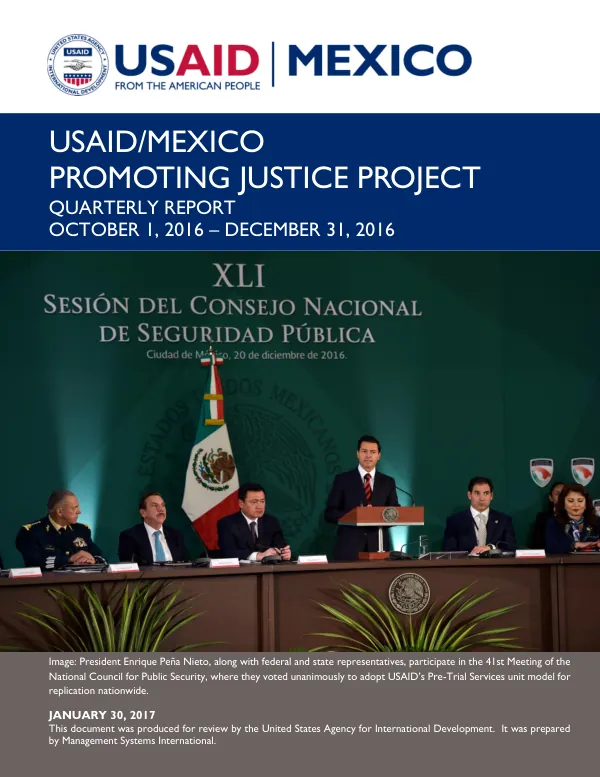
This quarterly report covers the period from October 1 to December 31, 2016, which corresponds to the first quarter (Q1) of Fiscal Year 2017. A key milestone this quarter was the adoption of USAID's proven Pre-Trial Services (PTS) model for replication nationwide. At the 41st Meeting of the National Council for Public Security held in Mexico City on 20 December 2016, the Council, presided over by Mexican President, Enrique Peña Nieto, made history by unanimously agreeing to the rollout of the PTS model. This decision is a testament to the highly positive results achieved by USAID-supported PTS units, including an over 25% decrease in pre-trial detention rates between 2014 and 2015 in target states. To date, USAID's PROJUST has supported 21 states in PTS implementation across Mexico. In Q1, USAID's PROJUST recorded a number of other early wins as well as state level outcomes connected to higher-level results. The project improved the regulatory framework at the state level by providing models for organic and civil service regulations to 16 states and working with state representatives to customize them to the local context. The regulations are for State Courts, Public Defenders' (PD) and Attorneys General (AG) Offices. This quarter, PROJUST worked with justice institutions across six states to align organic regulations to the National Criminal Procedure Code. The project also provided support to State Courts in Coahuila, Jalisco, Morelos, and Nayarit. In Morelos, where political will for consolidation of the reform is high, USAID implemented a holistic support package to improve the efficiency of the Court. The package provides comprehensive support across multiple areas, including the alignment of organic regulations to the accusatory system. In Q1, PROJUST met with the State Court President, judges, and justices to garner buy-in for this support. These sessions bore positive results: the organic regulations were approved by the Court in October 2016. Regulations were also approved and published in Coahuila's State Court in this same month. State laws must also be aligned to national frameworks and the Constitution. Following a series of roundtable discussions to promote the National Juvenile Justice Law, the state of Tabasco requested additional assistance from PROJUST for legislative harmonization with the new Law. Passed in June 2016, the Law ensures protection of the rights of adolescents at the national and state levels throughout the criminal justice process. PROJUST presented a document to Tabasco's State Court, AG, and PD Offices that provides guidance to assist in the process of harmonization. The document was developed in conjunction with the Technical Secretariat of the Criminal Justice Implementation Commission (SETEC, acronym in Spanish). With these guidelines established, Tabasco can move forward with harmonization. The project's regulatory support goes hand-in-hand with institutional reorganization and constitutes a facilitated process that identifies, analyzes, and proposes changes. This allows the project to gain buy-in and customize organizational changes to the context of the state before institutionalizing them in the regulations. Through this dual approach, in Q1 PROJUST provided support to State Courts in Coahuila, Jalisco, Morelos, and Nayarit. In addition to regulatory reform, the project also focused on improving the operation of state justice institutions. PROJUST worked with justice institutions across six states to align organic regulations to the National Criminal Procedure Code. The project also provided support to State Courts in Coahuila, Jalisco, Morelos, and Nayarit. In Morelos, where political will for consolidation of the reform is high, USAID implemented a holistic support package to improve the efficiency of the Court. The project's achievements in Q1 demonstrate its commitment to improving the operation of state justice institutions and promoting justice in Mexico. The project's regulatory support and institutional reorganization efforts are key components of its strategy to achieve this goal. By working with justice institutions across the country, PROJUST is helping to build a more efficient and effective justice system that serves the needs of all Mexicans. The project's national level support activities also continued in Q1. PROJUST worked with the National Council for Public Security to promote the adoption of the PTS model nationwide. The project also provided technical assistance to the Technical Secretariat of the Criminal Justice Implementation Commission (SETEC) to support the implementation of the National Juvenile Justice Law. In conclusion, the USAID/Mexico Promoting Justice Project (PROJUST) made significant progress in Q1 of Fiscal Year 2017. The project's achievements in regulatory reform, institutional reorganization, and national level support demonstrate its commitment to improving the operation of state justice institutions and promoting justice in Mexico. The project's work in Q1 sets the stage for continued progress in the coming quarters and reinforces its position as a key partner in the effort to build a more efficient and effective justice system in Mexico.