USAID DEC
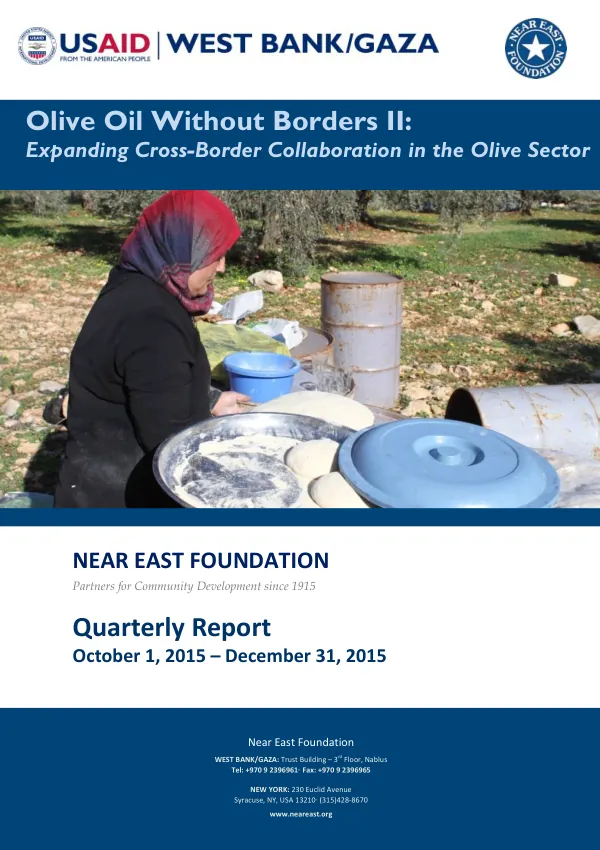
Quarterly Report: Olive Oil Without Borders II: Expanding Cross-Border Collaboration in the Olive Sector
Sign inMINISTRY OF AGRICULTURE
Quarterly Report: Olive Oil Without Borders II: Expanding Cross-Border Collaboration in the Olive Sector
The Olive Oil Without Borders II Project is continuing to make important progress towards fostering economic collaboration and opportunity among Palestinians and Israelis in the olive sector.
2016 · 27 pages
Sign in to readA free account is required to download.
Abstract
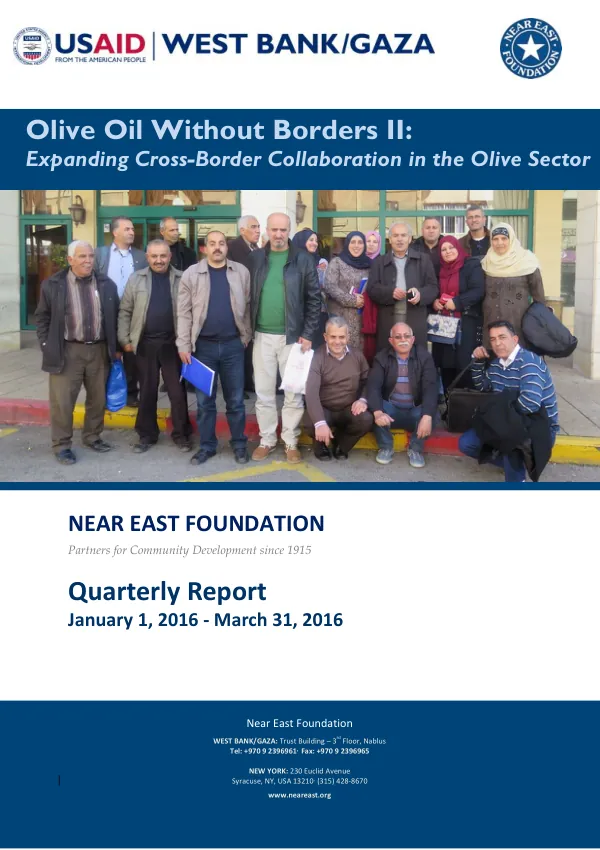
This report summarizes the activities and impact during the project's sixth quarter, from January 1, 2016 – March 31, 2016. Key accomplishments and impacts during the reporting period include the Israeli and Palestinian Olive Oil Councils continuing to meet quarterly to discuss areas of mutual concern and share strategies for promoting olive oil production and sales. The Joint Olive Oil Advisory Committee approved four research activities for funding, which will focus on the use of olive cakes, mulch, and zibar, and possible treatments for Peacock Spot Disease. These joint actions will contribute to the sharing of research findings and learning between Israeli and Palestinian olive oil actors. Additionally, 29 farmers participated in a joint two-day lead farmer training of trainers (TOT) workshop in Nazareth, facilitated by project champions, which provided an opportunity for Israeli and Palestinian lead farmers to learn new techniques together and share their experiences. The project also facilitated 242 farmers participating in 9 peer-to-peer sessions in 9 villages in Israel and the West Bank, promoting the sharing of new practices learned by lead farmers and champions. Furthermore, 4 Farmer Field School locations were selected in Arrabeh, Deir Sharaf, Aqqaba, and Asira, with activities to begin in these locations during the next quarter. A Palestinian company, Al Kharoube for Agri-supplies, became a distributor for an olive flytrap produced by an Israeli company, Biofeed, providing a new, affordable, and effective technology for Palestinian farmers. The project team hosted a number of visits to project sites and participated in a U.S. Congressional Delegation meeting. The project continues to implement activities as outlined in its implementation plan and is having an important impact. The Olive Oil Without Borders II: Palestinian-Israeli Olive Oil Project works to build relationships of trust, mutual understanding, and collaboration through economic cooperation. Building on the success and momentum of the USAID-funded Olive Oil without Borders (OOWB) project, NEF aims to strengthen linkages between Israeli and West Bank olive industry leaders and to expand to new communities and regions. The project will work with 1,500 olive farmers in 58 communities in the West Bank and Israel to build working relationships between business, policy, and academic leaders through cross-border workshops and joint initiatives. The project will also expand economic cooperation to farmers, mill owners, and distributors in 34 current villages and in 24 new villages, and develop 50 ancillary businesses, including cross-border collaboration between women's fair-trade associations. The Olive Oil Without Borders II project is based on the hypothesis that cross-border economic cooperation offers a structured depoliticized process for building trust, relationships, mutual understanding, and capacity for collective action in pursuit of shared economic interests. NEF takes a value chain approach to strengthen the olive oil sector in Israel and the West Bank through cooperation at many levels. The project's hypothesis is based on the understanding that economic cooperation and social/political reconciliation are parallel processes. Economic cooperation depends on and builds trust, communication, and sustained relationships. Building trust and social capital depends on understanding common interests and constraints, identifying opportunities for collaborative, mutually beneficial activities, and repeating interactions over time. Value chain development is based on stakeholders working together to strengthen a sector as a whole; the win-win solutions that emerge help build lasting trust and social capital. Economic cooperation has spillover effects in other spheres of social and political life. Strengthening business relationships lays the groundwork for four necessary components of reconciliation: the structural environment becomes more conducive to exchange and cooperation; new narratives emerge about the 'problems' and 'the other side' that are more conducive to collaboration and trust; there is movement away from positional bargaining toward interest-based negotiation; and heightened emotional reactions to conflicts in an economic sector are replaced with more rational and deliberative forms of expression. The project's activities and accomplishments are focused on achieving its objectives, including strengthening cross-border cooperation and leadership development through joint marketing and applied research. The project's implementation plan outlines specific activities and milestones, which are being met through the efforts of the project team and its partners. The project's impact is being monitored and evaluated through a range of indicators, including the number of farmers participating in joint activities, the number of research activities approved, and the number of ancillary businesses developed. The project's geographic focus is on the West Bank and Israel, with a particular emphasis on the olive oil sector. The project's timeframes are quarterly, with a focus on achieving specific milestones and outcomes during each quarter. The project's recommendations are based on its findings and impact, and are aimed at supporting the continued development of the olive oil sector in the region.
Related documents