USAID DEC
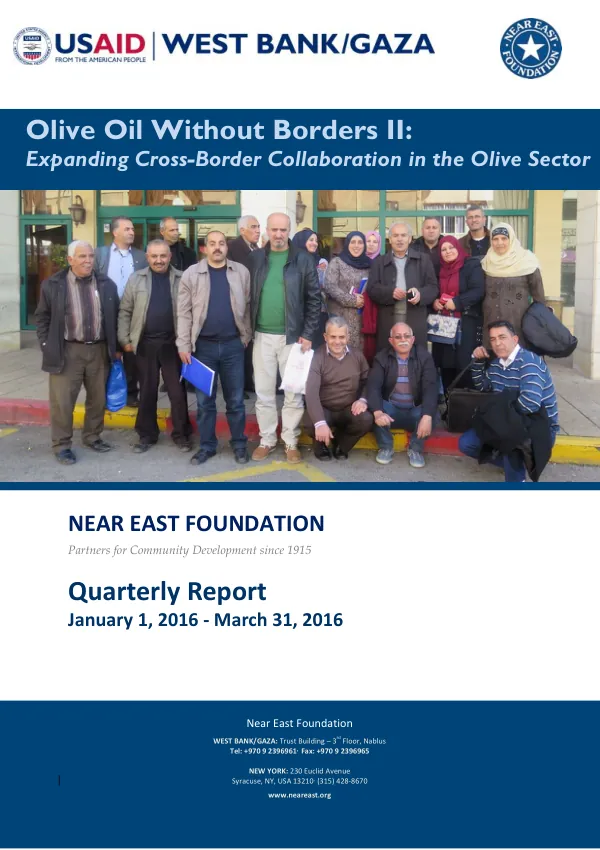
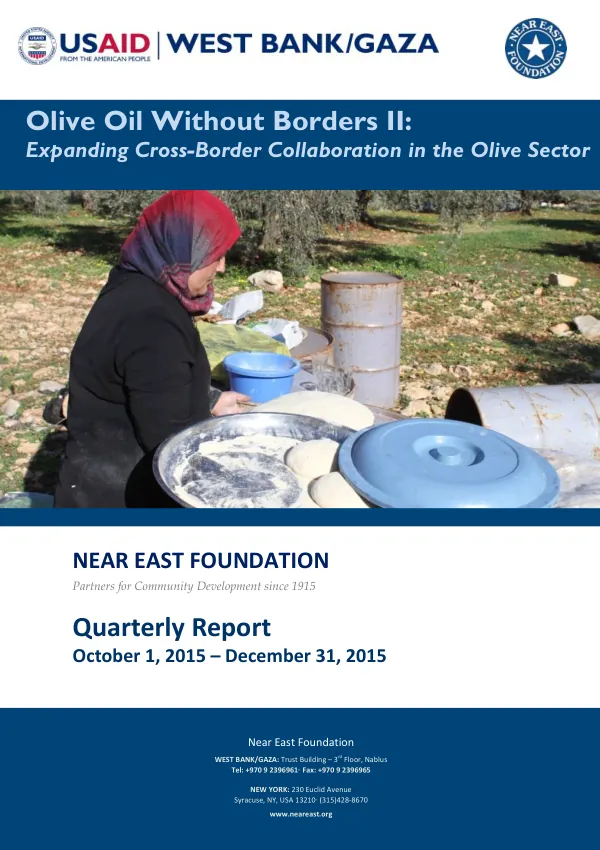
Quarterly Report: Olive Oil Without Borders II: Expanding Cross-Border Collaboration in the Olive Sector
Sign inMINISTRY OF AGRICULTURE
Quarterly Report: Olive Oil Without Borders II: Expanding Cross-Border Collaboration in the Olive Sector
The Olive Oil Without Borders II Project is a collaborative initiative between Palestinians and Israelis in the olive sector.
2015 · 29 pages
Sign in to readA free account is required to download.
Abstract
The project aims to foster economic collaboration and opportunity among the two groups. Key accomplishments during the project's fifth quarter, from October 1, 2015, to December 31, 2015, include a joint study tour to Spain, where 10 participants (5 Israelis and 5 Palestinians) learned improved techniques for harvesting and producing Extra Virgin Olive Oil. This joint event allowed participants to gain new knowledge and discuss possibilities for cooperation, including the creation of a joint marketing company to market cross-border olive oil production. The Joint Advisory Committee met to discuss joint scientific studies and activities, as well as strategies to develop the technical and managerial capacities of people who work in the olive sector, particularly women. In December, the Committee issued a joint call for proposals through the IOOC and POOC for cross-border collaborative studies and activities. The Palestinian and Israeli Olive Oil Councils (POOC and IOOC) came together in another joint quarterly meeting to discuss cooperation and jointly developed a training program for farmers on both sides to improve olive oil production. Capacity building workshops were hosted for members of the POOC, focusing on marketing, cross-border cooperation, and conflict mitigation. Through these workshops, POOC staff improved their management skills, and members indicated that they are now better able to prepare budgets, manage transactions, and prepare financial reports. An olive harvesting event was also hosted in December on an OOWB beneficiary farm in Asira, with the participation of 26 individuals (25 Palestinian, 1 Israeli), the US Consul General, and representatives from USAID. The project selected 6 new project champions, who will meet with the original 9 champions and assist in the lead farmer trainings. The project also selected 20 new lead farmers. The project continues to implement activities as outlined in its implementation plan and is having an important impact. The Olive Oil Without Borders II project works to build relationships of trust, mutual understanding, and collaboration through economic cooperation. Building on the success and momentum of the USAID-funded Olive Oil without Borders (OOWB) project, NEF aims to strengthen linkages between Israeli and West Bank olive industry leaders and to expand to new communities and regions. The project will work with 1,500 olive farmers in 58 communities in the West Bank and Israel to build working relationships between business, policy, and academic leaders through cross-border workshops and joint initiatives. The project is based on the hypothesis that cross-border economic cooperation offers a structured depoliticized process for building trust, relationships, mutual understanding, and capacity for collective action in pursuit of shared economic interests. NEF takes a value chain approach to strengthen the olive oil sector in Israel and the West Bank through cooperation at many levels. The project aims to strengthen business relationships, which lays the groundwork for four necessary components of reconciliation: the structural environment becomes more conducive to exchange and cooperation, new narratives emerge about the 'problems' and 'the other side' that are more conducive to collaboration and trust, there is movement away from positional bargaining toward interest-based negotiation, and heightened emotional connections. The project's implementation plan includes expanding economic cooperation to farmers, mill owners, and distributors in 34 current villages and in 24 new villages, and developing 50 ancillary businesses, including cross-border collaboration between women's fair-trade associations. The project's progress is being monitored through project indicators and impact, which will be reported in future quarterly reports.
Related documents