USAID DEC
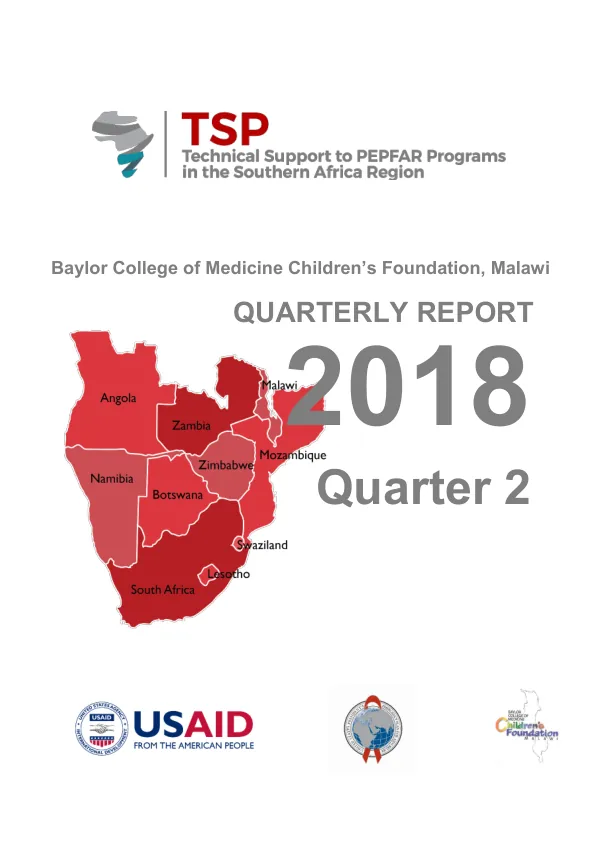
Quarterly Report: Technical Support to PEPFAR Programs in the Southern Africa Region (TSP) project
Sign inUSAID
Quarterly Report: Technical Support to PEPFAR Programs in the Southern Africa Region (TSP) project
The Technical Support to PEPFAR Programs in the Southern Africa Region (TSP) project, implemented by Baylor College of Medicine Children’s Foundation Malawi, is a collaborative effort to strengthen the HIV response in specific countries and across the region.
2018 · 38 pages
Sign in to readA free account is required to download.
Abstract
The project focuses on promoting evidence-based best practices for programming, including generating and identifying evidence-based best practices, providing direct implementation and technical assistance, integrating best practices into policy, and disseminating best practices to relevant audiences. In quarter two of the financial year 2018, TSP oversaw 11 active engagements, including seven Core funded and four Country Buy-in funded engagements in Lesotho, Namibia, and Swaziland. The project's key achievements in quarter two include the successful implementation of technical assistance for the Lesotho Pediatric and Adolescent HIV Program (MELD). The MELD project conducted 102 mentoring sessions at 36 health facilities, supporting direct service provision to 1,101 clients. The project also provided onsite training to 149 health care workers from 13 health facilities and offsite training to 74 health care workers from 21 health facilities. Another key achievement in quarter two was the development of training materials for enhanced referral strategies for index case testing in Malawi. TSP trained 166 Ministry of Health and Baylor-Malawi staff from eight health facilities in Mangochi, and systematic screening of clients at ART clinics within the health facilities has begun. All sites now have index case testing registers and supervision is ongoing. In addition, TSP held 27 teen clubs in 24 sites in Malawi, which were attended by 1,414 adolescents in February and March 2018. The project also developed an annual schedule for teen clubs to be held every second month, as well as two guardian sessions at each site. M&E tools for the program were rolled out at the end of the quarter, and the development of the community health worker youth supporter program is in process. The project also made significant progress in Namibia, including the development of combination prevention guidelines. The TSP Strategic Advisor developed the draft guidelines, which were reviewed and validated at a second stakeholder meeting in February, and incorporated feedback from the Ministry of Health and Social Services (MoHSS) and USAID. The final guidelines were submitted to the MoHSS, USAID/Namibia, and TSP on April 18, 2018. Furthermore, TSP held an initial stakeholder meeting on January 30 and conducted site visits to six health facilities in two regions from March 7-23, 2018. TSP presented key findings to USAID/Namibia and developed an interim report including an assessment of site-level services and documentation as well as data analysis of the PMTCT cascade and linkage breaks. The project also transitioned from Management Sciences for Health to TSP in March 2018, and held a transition event with more than 30 key stakeholders, including the Ministry of Health and USAID. TSP provided technical assistance to its 14 supported health facilities in four regions of the country, and supported national-level activities, including an assessment on voluntary medical male circumcision integration and transition to a new adult anti-retroviral therapy (ART) regimen. Overall, the TSP project has made significant progress in quarter two, strengthening the HIV response in specific countries and across the region. The project's focus on promoting evidence-based best practices for programming has led to improved service delivery and better health outcomes for clients.