FAO
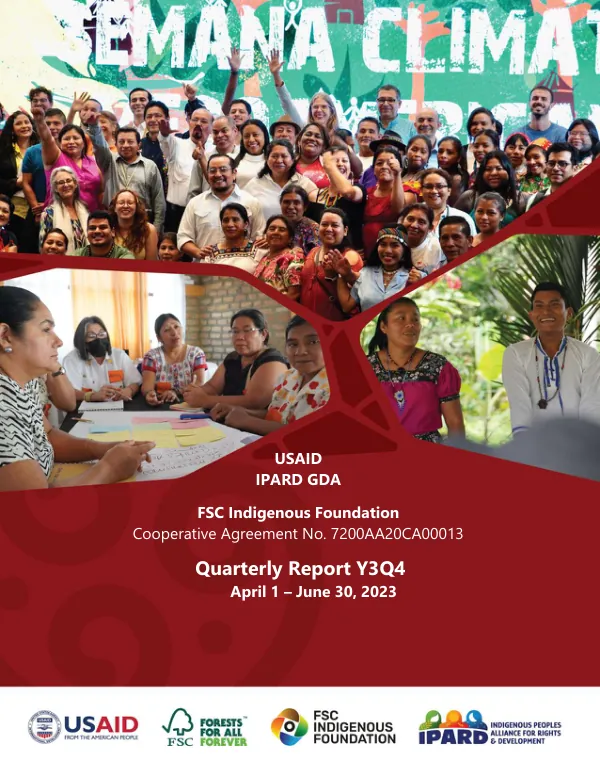
Quarterly Report Y3Q4
The Indigenous Peoples Alliance for Rights and Development (IPARD) Program, funded by the United States Agency for International Development (USAID) and the Forest Stewardship Council (FSC), has achieved significant milestones during the third quarter of Fiscal Year 2021-22.
2023 · 62 pages
Sign in to readA free account is required to download.
Abstract
The program's activities are implemented by the FSC Indigenous Foundation (FSC-IF), which is responsible for producing this quarterly report. At the global level, the IPARD Program has continued to enhance the Virtual Learning Database (VLD), a platform that provides training and capacity-building opportunities for Indigenous Peoples. The VLD platform has undergone data cleaning, adjustments, and improvements, and a database migration has been conducted. Additionally, the Environmental Systems Research Institute (ESRI) has been working on adding layers to the global map and creating an application to publish IPARD's work in Panama. A GIS online training for a selected Indigenous youth from Mexico is scheduled to take place in July 2023. The program has also engaged with various stakeholders, including a presentation of IPARD interns to Florida State University (FSU), a draft Memorandum of Understanding (MoU) between FSC-IF and FSU and Universidad Tecnológica de Panamá (UTP), and hosting of IPARD interns from Nebrija University in Madrid. Furthermore, the program has conducted procurement processes for activities to be implemented in Year 4, including the Indigenous Organization Capacity Assessment tool (I-OCA), Internal Capacity Development Plan (ICDP), and selection process of 50 Indigenous Peoples for the Indigenous Fellowship Program (IFP). The FSC-IF Climate Change Strategy has been finalized and presented to the staff in two interactive workshops. In Year 4, the IPARD team will work on integrating the strategy into the program's activities. The program has also organized a side event at the UN Permanent Forum on Indigenous Peoples Issues in April 2023, which led to the establishment of connections with various global stakeholders and the presentation and launch of the new FSC-IF Global Strategy. Other global activities include the decision to pilot the Center for Indigenous Innovation and Business Development (CIIBD) in two countries, one in Africa and the other in Central America, and the signing of a contract between FSC-IF and the Impact Hub Network to develop a research roadmap to explore, analyze, and validate existing knowledge pools of Indigenous business support. The program has also procured a project with Sistema B to build a global replicable trade impact model to better connect Indigenous-led businesses with the private sector in Colombia and Peru. At the regional level, the program has re-engaged with IPARD's partners in Africa, including the Indigenous Peoples of Africa Coordinating Committee (IPACC) and the Communities for the Sustainable Management of the Forest Ecosystems of Central Africa (REPALEAC). REPALEAC has identified training for 25 people in advocacy, leadership, communication, project management, FPIC, FSC principles and standards, USAID Indigenous Peoples' Policy, and data collection as its short-term activities. IPACC activities include training on women's rights, gender, and research, and digital documentation for youth at the regional level. The program has also identified ILO Convention 169-linked capacities building activities in Latin America and Africa and is supporting nine scholarships for Indigenous Peoples leaders from Brazil, Colombia, Costa Rica, Ecuador, Panama, Peru, and other countries.
Related documents