FAMILY HEALTH INTERNATIONAL 360
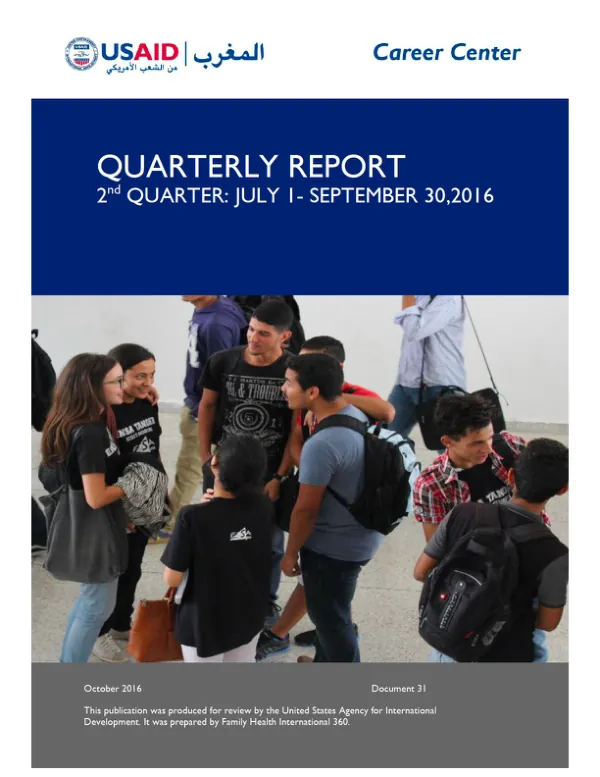
Quarterly Report – Year Two, 2nd Quarter
USAID Career Center is a program aimed at enhancing the employability of target youth in Morocco.
2016 · 54 pages
Sign in to readA free account is required to download.
Abstract
The program is implemented by FHI360, with a contract number of AID-608-C-15-00004 and a request project number of REQ-608-14-000023. The program's development objective is to enhance the employability of target youth, and it is being implemented in the regions of Tangier, Casablanca, and Marrakech. During the second quarter of 2016, which spans from July 1 to September 30, the program continued to focus on establishing Career Centers in collaboration with USAID and program partners. The program's efforts were centered on preparing and initiating the Career Centers in the program's geographic regions. Key activities included working with host-institutions to confirm sites for the Career Centers, recruiting Career Center staff, and providing ongoing training to Career Center staff. The program also developed a new Career Center management and tracking tool, which is expected to enhance the efficiency and effectiveness of the Career Centers. Additionally, the program continued to develop the Virtual Career Center, which provides a range of services to support youth employability. The program's work readiness curricula were also developed based on feedback from industry analysis reports, youth feedback, trainer feedback, and private sector partners' inputs. The program's outreach efforts continued during the second quarter, with a focus on engaging with private and public sector partners to support the Career Centers. The program's industry analysis reports and youth feedback were used to inform the development of the work readiness curricula, which are designed to equip youth with the skills and knowledge required to succeed in the labor market. The program's progress was monitored and evaluated during the second quarter, with a focus on tracking key indicators and assessing the program's impact. The program's stakeholders, including USAID and program partners, were engaged throughout the quarter to ensure that the program's efforts were aligned with their needs and expectations. The program's lessons learned during the second quarter highlighted the importance of ongoing training and capacity building for Career Center staff. The program also recognized the need to continue engaging with private and public sector partners to support the Career Centers and to ensure that the program's efforts were aligned with the needs of the labor market. The program's sustainability was a key consideration during the second quarter, with a focus on ensuring that the Career Centers were established in a way that would allow them to continue operating beyond the program's lifespan. The program's management and administrative issues were also addressed during the quarter, with a focus on ensuring that the program's operations were efficient and effective. The program's branding, outreach, and communications efforts continued during the second quarter, with a focus on promoting the Career Centers and engaging with stakeholders. The program's calendar of planned outreach and communications events was developed during the quarter, with a focus on promoting the Career Centers and engaging with stakeholders. The program's planned activities for the next quarter were also developed during the second quarter, with a focus on continuing to establish the Career Centers and to support the employability of target youth in Morocco. The program's indicators and targets were reviewed and updated during the quarter, with a focus on ensuring that the program's efforts were aligned with its development objective. Overall, the second quarter of 2016 was a productive period for USAID Career Center, with a focus on establishing Career Centers and supporting the employability of target youth in Morocco. The program's efforts were centered on preparing and initiating the Career Centers, developing the Virtual Career Center, and engaging with private and public sector partners to support the Career Centers.