USAID DEC
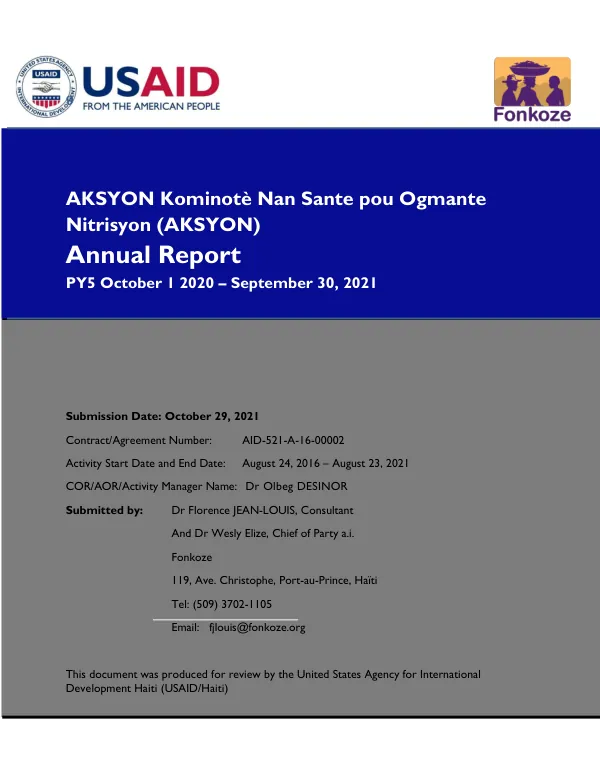
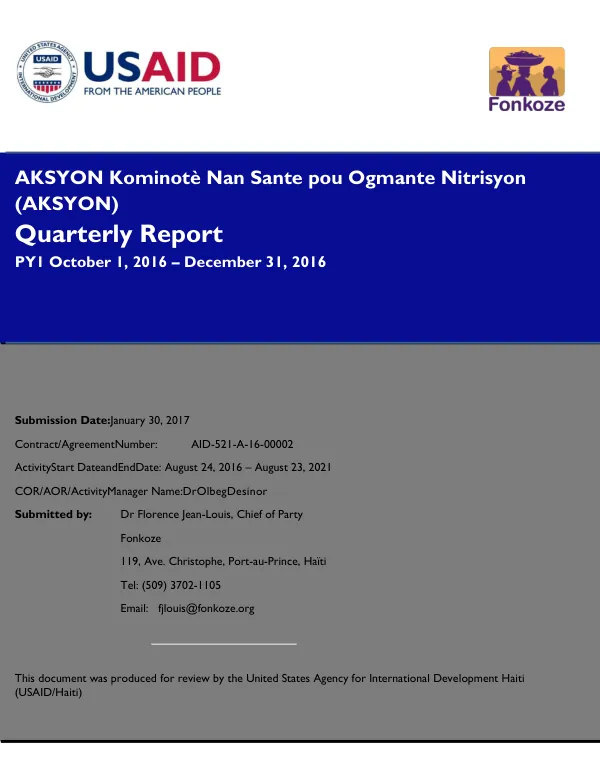
Quarterly ReportPY1 (October 1, 2016 – December 31, 2016)
AKSYON is a five-year program that aims to decrease the number of women and children under age five who suffer from malnutrition in rural Haiti.
2016 · 19 pages
Sign in to readA free account is required to download.
Abstract
The program is implemented by Fonkoze, the largest microfinance institution in Haiti, and is supported by the United States Agency for International Development (USAID). AKSYON addresses malnutrition in Haiti through Fonkoze's existing infrastructure, network, and health program. The program focuses on providing education and outreach to the entire Fonkoze client network, which consists of 60,000 clients in its core lending program. Fonkoze Foundation is leveraging its network to address the lack of reliable and affordable health products and services in rural Haiti. The program enables Fonkoze to deepen its malnutrition interventions through its BoutikSante Program, which is a self-sustaining social franchising initiative. The BoutikSante Program trains Community Health Entrepreneurs (CHEs) to administer basic health screenings, deliver monthly health education sessions, and sell health products to their clients. CHEs purchase health products from Fonkoze to sell in their microenterprises, establishing a community health store. The program also conducts screening campaigns to identify cases of Severe Acute Malnutrition (SAM) and Moderate Acute Malnutrition (MAM), and provides appropriate care and follow-up as dictated by Ministry of Health protocol. By 2021, AKSYON aims to reach full-scale, with 1,800 entrepreneurs serving over two million Haitians. The program is designed to be sustainable and perpetuated by the market, with initial start-up costs covered by donors. Researchers from the Icahn School of Medicine at Mount Sinai are monitoring the program roll-out to assess sustainability and impacts on health outcomes. The program's indicators include a 20% decrease in the number of children under age 5 who are stunted, and a reduction and maintenance of childhood wasting to less than 5%. The program has made progress in its first year, with 353 children under 5 screened, 137 children 0-23 months screened, and 62 pregnant/lactating women screened. The program has also identified 18 cases of MAM and treated 3,440 cases of MAM. The program has trained 600 CHEs to screen, identify, and follow-up on malnourished individuals, and has conducted 13,755 home visits. The program has also reached 332 community members with WASH and nutrition-sensitive topics, and has provided sustainable garden training to 200 participants. The program aims to continue its progress in the next quarter, with a focus on increasing the number of children screened and treated for malnutrition. The program's progress is monitored through a range of indicators, including the number of children under 5 screened, the number of MAM identified, and the number of SAM treated. The program's indicators are tracked on a quarterly basis, with a focus on progress towards the program's annual targets. The program's progress is also monitored through a range of qualitative indicators, including community feedback and community feedback on the program's impact. The program's sustainability is ensured through a range of mechanisms, including the establishment of a self-sustaining social franchising initiative, and the training of CHEs to administer basic health screenings and sell health products. The program's sustainability is also ensured through the support of researchers from the Icahn School of Medicine at Mount Sinai, who are monitoring the program roll-out to assess sustainability and impacts on health outcomes. The program's impact is expected to be significant, with a reduction in the number of women and children under age 5 who suffer from malnutrition. The program's impact is also expected to be sustained, with a focus on increasing the number of children screened and treated for malnutrition, and a focus on improving the health and nutrition of the population.