DIMAGI, INC.
AKSYON-Annual Report PY5 (October 1, 2020 – September 30, 2021)
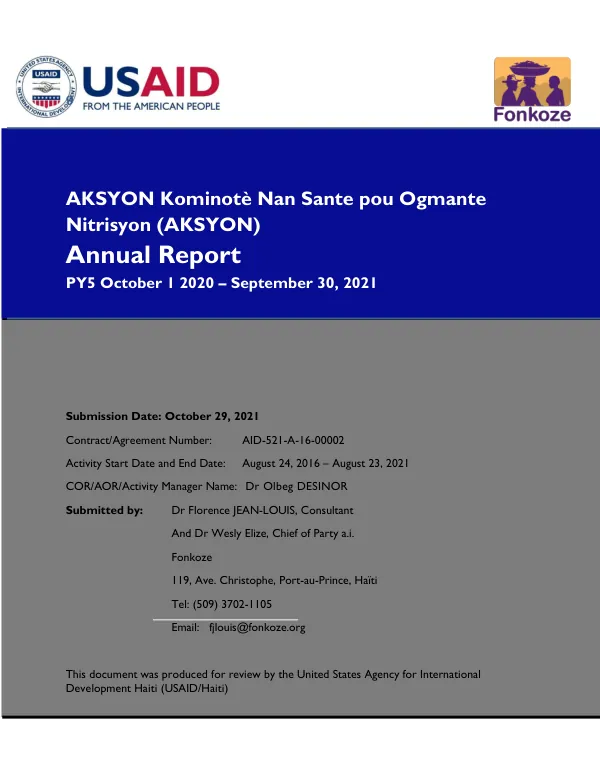
The AKSYON program is a five-year initiative aimed at reducing malnutrition among women and children under the age of five in rural Haiti.
2021 · 33 pages
Sign in to readA free account is required to download.
Abstract
The program is implemented by Fonkoze, the largest microfinance institution in Haiti, in partnership with various subcontractors and subawardees. AKSYON addresses malnutrition through education and outreach to Fonkoze's client network, leveraging the institution's existing infrastructure and health program. The program focuses on knowledge and skill building around nutrition, hygiene, sanitation, and food security strategies. Fonkoze's staff, including registered nurses, provides monthly trainings to Community Health Entrepreneurs (CHEs), who are representatives from each credit center. The CHEs are trained to administer basic health screenings and deliver community health education sessions. AKSYON's geographic coverage spans Haiti nationwide, with a focus on the departments of South, SouthEast, Grande Anse, Nippes, West, Center, Artibonite, North, NorthEast, and NorthWest. The program's activity start date is August 24, 2016, and the end date is December 23, 2021. The total estimated agreement amount is $18,000,000.00, with a revised agreement amount of $14,415,762.00. The program's implementation progress is monitored through various indicators, including the number of children screened for malnutrition, the outcome of children followed for malnutrition, and the sales of nutrition-sensitive products in communities served by AKSYON. The program's results to date show a decrease in malnutrition rates among children under the age of five. The AKSYON program has made significant progress in reducing malnutrition among women and children under the age of five in rural Haiti. The program's focus on education and outreach, combined with its leveraging of Fonkoze's existing infrastructure and health program, has enabled it to reach a large number of beneficiaries. The program's results demonstrate its effectiveness in addressing malnutrition in rural Haiti. The program's implementation challenges include the need to improve the quality of health services provided by CHEs and to increase the availability of health products and services in rural areas. The program's management and administrative issues are also being addressed through regular monitoring and evaluation. The AKSYON program's financial management is overseen by the USAID, with a total obligation of $14,415,762.00 and cash disbursements of $13,704,342.55. The program's estimated expenditure for the next quarter is $711,419.14. The program's conclusion highlights its achievements and challenges, as well as its plans for future implementation. The program's annexes provide additional information on its implementation progress, including tables and figures that illustrate its results. The AKSYON program's geographic coverage is extensive, with a focus on rural areas in Haiti. The program's implementation progress is monitored through various indicators, including the number of children screened for malnutrition and the outcome of children followed for malnutrition. The program's results demonstrate its effectiveness in addressing malnutrition in rural Haiti. The program's management and administrative issues are being addressed through regular monitoring and evaluation. The program's financial management is overseen by the USAID, with a total obligation of $14,415,762.00 and cash disbursements of $13,704,342.55. The program's estimated expenditure for the next quarter is $711,419.14.
Related documents