USAID DEC
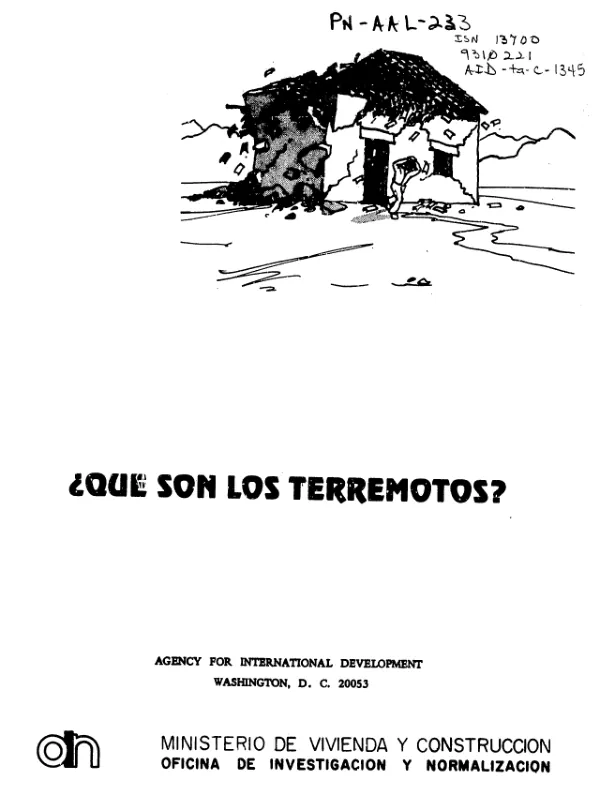
¿Qué son los terremotos?
The Agency for International Development and the Ministerio de Vivienda y Construcción's Oficina de Investigación y Normalización collaborated on a report to address common questions about earthquakes.
2010 · 21 pages
Sign in to readA free account is required to download.
Abstract
The report was supervised by Dr. Loren Raymond, a geologist from INTERTECT, and Dr. Daniel Huaco, from the Instituto Geofísico del Perú. Earthquakes occur when the edges of two tectonic plates meet. The Earth's surface is composed of large sections called plates, which are located beneath oceans and entire continents, such as South America, North America, and the Caribbean. These plates are in constant motion, although they move only a few centimeters each year. As a result, the plates collide at various points around the world, causing earthquakes. When two plates collide, one plate may attempt to slide under the other. This is what occurred in Peru, where the Placa Sudamericana and Placa Nazca meet. The point on the Earth's surface where the movement begins is called the epicenter of the earthquake. Vibrations, or waves, emanate from this point and travel in all directions, affecting the surrounding area. There are two main types of waves that affect buildings during an earthquake: lateral movement and oscillatory movement. Lateral movement causes the Earth to shift from side to side, resulting in a feeling of being pulled and pushed. Oscillatory movement, on the other hand, produces a wave-like motion, similar to the movement of ocean waves. This type of movement creates a sensation of being lifted and dropped. When an earthquake occurs, the ground begins to move laterally, causing the foundation and lower parts of a building to move in sync with the Earth. However, the roof and upper parts of the building tend to lag behind, resulting in a tilting motion. As the ground continues to move, the roof and upper parts of the building attempt to catch up, but the movement changes direction, causing the roof to move in the opposite direction and at a faster pace. This phenomenon can be observed when standing in a moving vehicle, where the sensation of being pushed backward and then forward is experienced.