USAID
Quick Tips on Key Features of Saving Group models
Saving Group models are designed to facilitate collective savings and lending among members, promoting financial stability and economic empowerment.
2016 · 3 pages
Sign in to readA free account is required to download.
Abstract
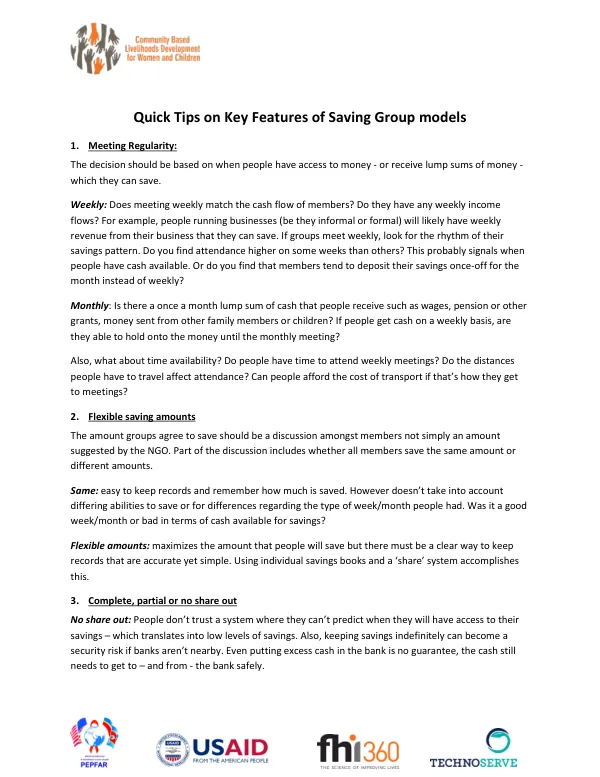
The decision on meeting regularity should be based on when members have access to money, such as weekly or monthly lump sums. Weekly meetings may be suitable for individuals with regular income flows, while monthly meetings may be more suitable for those with a once-a-month lump sum of cash. Flexible saving amounts are essential to accommodate differing abilities to save and varying cash availability. Members should discuss and agree on the amount to save, with options including the same amount for all members or different amounts based on individual circumstances. A clear record-keeping system is necessary to track savings and loans, with options including ledger accounts or individual savings books and a balances book. The latter option is simpler and more transparent, allowing members to easily understand their savings and loan balances. Record keepers find this system easy to learn, and it works well with flexible savings or share systems. However, it may not satisfy accounting requirements. Groups choose the monthly interest rate for loans issued from their pooled savings, with a standard rate of 10% per month. There are two options for calculating interest: the flat method, where the same interest rate is charged throughout the loan, and the declining method, where interest is calculated on the remaining balance after each payment. A management committee is elected by members to oversee the group's activities, including a chairperson, recordkeeper/secretary, and money counters. The committee should hold annual elections and establish term limits to ensure rotation of leadership. A constitution is essential to maintain discipline, transparency, and trust within the group, outlining basic information, objectives, membership, and rules for savings and loan disbursement. Training and monitoring schedules should be tailored to the context, member types, and practitioner resources. The goal is to equip members to become self-sustaining over time, without overburdening them with excessive training or monitoring. Monitoring should continue until the group becomes competent and confident, but not so long as to foster dependency.