USAID DEC
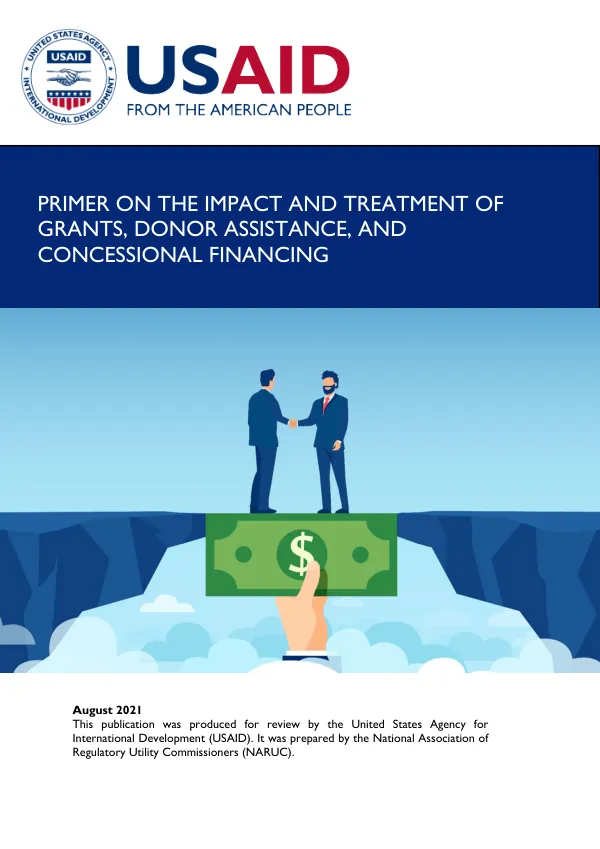
Primer on the Impact and Treatment of Grants, Donor Assistance, and Concessional Financing
Sign inTHE CADMUS GROUP, INC.
Primer on the Impact and Treatment of Grants, Donor Assistance, and Concessional Financing
Concessional financing instruments are used to support development projects in developing countries.
2021 · 44 pages
Sign in to readA free account is required to download.
Abstract
Blended concessional finance combines concessional loans with commercial financing to reduce the financial burden on borrowers. This approach allows for the addition of private sector investment, promoting commercial sustainability, and reinforcing markets. Concessional finance can have a positive impact on private investment, but it can also have negative effects on financial management and the regulatory environment. The treatment of concessional finance in rate base and tariff design is a critical issue in the electricity sector. Concessional finance can affect the revenue requirement formula, leading to changes in the rate base and tariff. The impact of concessional finance on the rate base and tariff is a complex issue, and different models can be used to calculate the impact. The grant/long-term contribution model and the returnable-capital model are two common models used to calculate the impact of concessional finance on the rate base and tariff. The use of concessional finance can have a significant impact on the financial sustainability of utilities. Utilities that rely heavily on concessional finance may struggle to maintain financial sustainability, leading to a decrease in their credit rating and an increase in their cost of capital. The use of concessional finance can also have a negative impact on the regulatory environment, leading to a decrease in the level of investment in the utility. The regulatory environment plays a critical role in determining the impact of concessional finance on the rate base and tariff. Utilities that operate in a regulatory environment that is supportive of concessional finance are more likely to benefit from this type of financing. In contrast, utilities that operate in a regulatory environment that is hostile to concessional finance are more likely to struggle with financial sustainability. The use of concessional finance can have a positive impact on the social returns of utilities. Utilities that use concessional finance to invest in renewable energy and other sustainable technologies can reduce their environmental impact and improve their social returns. However, the use of concessional finance can also have a negative impact on the social returns of utilities, particularly if the financing is used to invest in projects that have a low social return. The treatment of concessional finance in rate design is a critical issue in the electricity sector. Utilities that use concessional finance to invest in projects that have a high social return are more likely to benefit from this type of financing. In contrast, utilities that use concessional finance to invest in projects that have a low social return are more likely to struggle with financial sustainability.