CHEMONICS
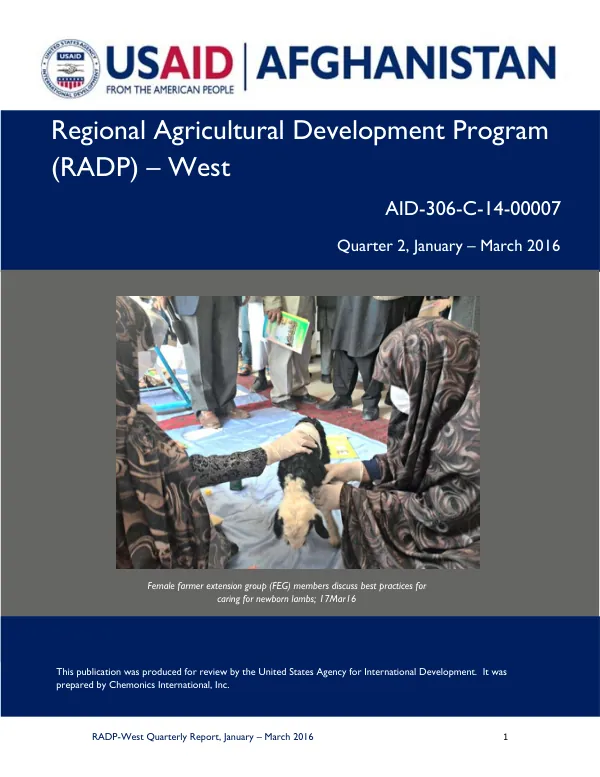
RADP-West Quarterly Report, January – March 2016
Regional Agricultural Development Program (RADP) - West implemented a comprehensive agricultural development initiative in Afghanistan from August 2014 to August 2019.
2016 · 42 pages
Sign in to readA free account is required to download.
Abstract
The program aimed to improve agricultural productivity, increase farmers' income, and enhance food security in the target provinces. RADP-West covered 14 provinces, including Herat, Badghis, and Farah, with a focus on wheat, high-value crops, and livestock value chains. The program's key interventions included wheat value chain programming, high-value crops value chain programming, livestock value chain programming, and enabling environment programming. Wheat value chain programming involved training farmers in improved wheat cultivation practices, while high-value crops value chain programming focused on promoting the cultivation of high-value crops such as vegetables and fruits. Livestock value chain programming aimed to improve the productivity and income of livestock farmers through training and support services. Enabling environment programming involved activities such as capacity building for government officials, farmers' organizations, and other stakeholders to create an enabling environment for agricultural development. Cross-cutting themes, including gender and nutrition, were also addressed through various activities such as training programs for female farmers and nutrition education. During the quarter, RADP-West achieved several key accomplishments, including the establishment of new farmer extension groups (FEGs) and self-help groups (SHGs) in target districts. The program also conducted training programs for farmers on improved wheat cultivation practices, vegetable cultivation, and livestock management. In addition, RADP-West supported the establishment of demonstration training centers (DTCs) for wheat and high-value crops, and facilitated the signing of contract agreements between livestock beneficiaries and a cashmere processing company. The program's staff numbers increased during the quarter, with a total of 25 staff members as of March 31, 2016. RADP-West collaborated with various stakeholders, including the Government of the Islamic Republic of Afghanistan, USAID-funded projects, and non-USAID funded projects. The program also worked with local organizations, such as the Afghanistan Agricultural Extension Program (AAEP) and the Afghanistan National Horticulture Development Organization (ANHDO), to achieve its objectives. The program's activities were supported by various partners, including the Agency for Rehabilitation and Energy Conservation in Afghanistan (AREA), the Dutch Committee for Afghanistan (DCA), Equal Access (EA), and Services International LLC (SIL). The program's budget was managed through a contract agreement with the United States Agency for International Development (USAID), with a total budget of $306,000 for the quarter. Overall, RADP-West made significant progress in achieving its objectives during the quarter, with a focus on improving agricultural productivity, increasing farmers' income, and enhancing food security in the target provinces.