CHEMONICS
RADP-West Monthly Report, February 2016
Regional Agricultural Development Program (RADP) - West is a five-year initiative funded by the United States Agency for International Development (USAID) and implemented by Chemonics International Inc.
2016 · 22 pages
Sign in to readA free account is required to download.
Abstract
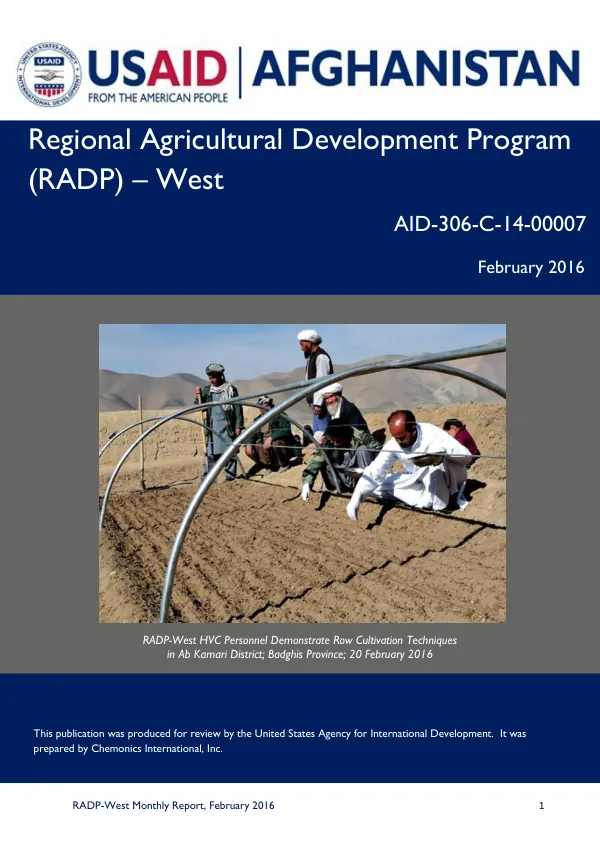
The project aims to improve food and economic security for rural Afghans in 13 targeted districts within Herat, Farah, and Badghis provinces. RADP-West is working in partnership with the Ministry of Agriculture, Irrigation, and Livestock (MAIL) to support the development of sustainable agricultural development, which will support the consolidation of licit economies, fuel economic growth, and provide alternatives to poppy cultivation. The project's specific focus is to support MAIL in improving the productivity and profitability of targeted value chains within the Wheat, High Value Crops (HVC), and Livestock value chains. The project's Enabling Environment Department is designed to support MAIL in its efforts to adopt longer-term improvements in national agricultural policy and regulatory development. Chemonics implements the RADP-West project with the support of Key Implementing Partners (KIPs), including Agency For Rehabilitation and Energy Conservation in Afghanistan (AREA), Dutch Committee for Afghanistan (DCA), International Center for Agricultural Research in Dry Areas (ICARDA), and Equal Access. During the month of February, RADP-West continued Wheat, High Value Crop (HVC), Livestock, Enabling Environment, and Gender and Nutrition activities across selected districts within Herat, Farah, and Badghis provinces. The project's Wheat Value Chain Programming focused on improving wheat production and productivity, while the High Value Crops Value Chain Programming aimed to increase the production and marketing of high-value crops such as fruits and vegetables. The Livestock Value Chain Programming focused on improving the productivity and profitability of livestock production, while the Enabling Environment Programming supported MAIL in its efforts to adopt longer-term improvements in national agricultural policy and regulatory development. The project's Gender and Nutrition Programming aimed to improve the nutritional status of rural Afghans, particularly women and children, through the promotion of nutrition-sensitive agriculture and the provision of nutrition education and training. The project also continued to engage with local stakeholders, including government officials, farmers, and community leaders, to build support for the project's activities and ensure their sustainability. The project's Key Implementing Partners (KIPs) continued to play a crucial role in implementing the project's activities. AREA focused on wheat and high-value crop production in Badghis province, while DCA worked on livestock value chain programming in Herat, Badghis, and Farah provinces. ICARDA focused on wheat and high-value crop production in Farah province, and Equal Access worked on communications programming in Herat, Badghis, and Farah provinces. The project's progress was monitored and evaluated through regular reporting and monitoring and evaluation (M&E) activities. The project's indicators, including the number of farmers trained, the amount of wheat and high-value crops produced, and the number of livestock vaccinated, were tracked and reported on a regular basis. The project's M&E system also included regular field visits and surveys to assess the project's impact and identify areas for improvement. Overall, RADP-West continued to make progress in its efforts to improve food and economic security for rural Afghans in 13 targeted districts within Herat, Farah, and Badghis provinces. The project's activities and achievements during the month of February demonstrate its commitment to supporting the development of sustainable agricultural development in Afghanistan.