DAI
RAMP UP East Quarterly Report July 1 – September 30, 2011
Regional Afghan Municipalities Program for Urban Populations – Regional Command East began its First Option Year in July 2011, marking the second year of program implementation.
2011 · 44 pages
Sign in to readA free account is required to download.
Abstract
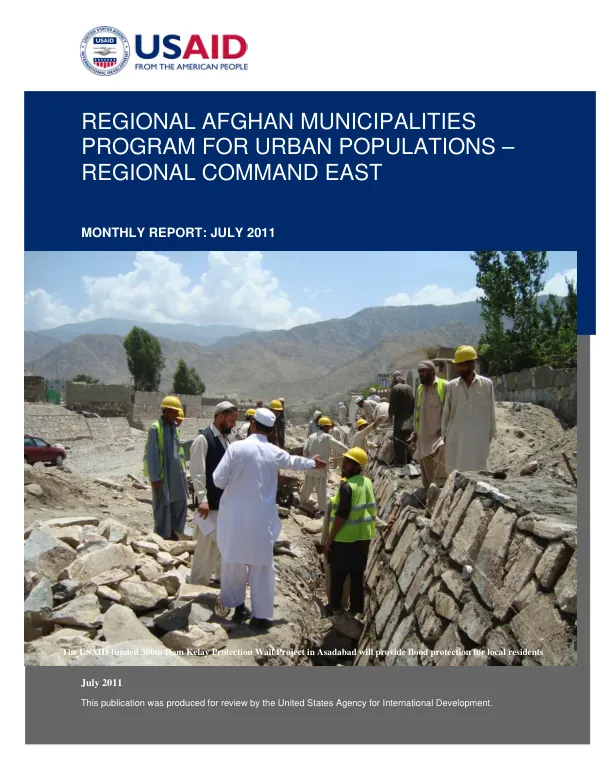
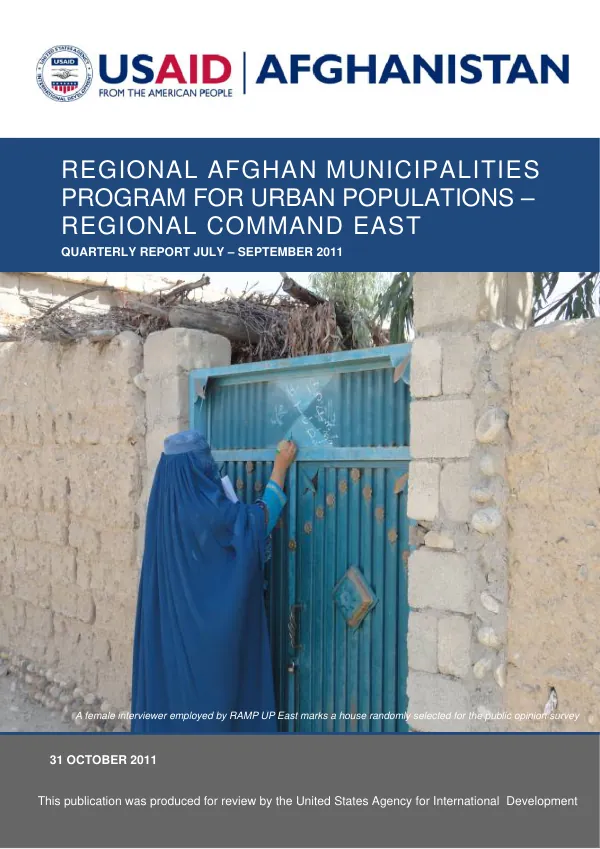
The program aimed to improve municipal service delivery and infrastructure in 13 municipalities across Regional Command East. Assistance Objective (AO) indicator targets were measured by intermediate (quarterly) indicators defined in the RAMP UP East Performance Monitoring Plan. Capacity building of municipal officials was a key focus area, with RAMP UP East working with municipal finance and budget units to improve their processes and systems. A diagnostic survey at the beginning of the project showed that budgeting and finance processes were rudimentary and manually intensive. To institute changes, RAMP UP East conducted group trainings, coaching, and mentoring on accounting and budgeting, including forecasting. Embedded advisors collaborated with their counterparts to computerize accounting records, and training materials for the forecasting module were developed. Citizen satisfaction with municipal government was also a key indicator, with preliminary results of the annual public opinion survey showing an increase over baseline survey results for all four indicators. The survey involved 3,300 randomly selected respondents and focused on citizen satisfaction with the municipal government, perception that local officials are working to serve citizens' needs, trust in municipal officials to conduct activities that benefit the people, and an increase in access to services provided by the municipality. Service delivery and infrastructure projects were also underway, with RAMP UP East assisting 13 municipal government units in improving the delivery of public services to constituents. Solid waste management (SWM) projects were underway in seven municipalities, providing employment to citizens and on-the-job learning opportunities for municipal officials. A total of 36 infrastructure projects were currently ongoing, while two projects – a protection wall in Asadabad and a parking lot in Pul-i-Alam – were completed during this period. Municipal officials have been working to improve their communication with local citizens, using multiple methods to convey information and provide opportunities for constituents to give comments and air their concerns. Twelve municipalities held citizen forums to inform and engage citizens in municipal activities, while six municipalities continued to use the community newsletter to communicate municipal accomplishments and address citizen concerns. Five towns used mass media to disseminate information through radio interviews. Despite challenges that impacted the performance of the program, there were successes and anecdotes worthy of highlighting, and good practices for programming in a less-permissive environment. The security situation in Pul-i-Alam improved to a level that allowed the project management to oversee the public opinion household survey, which was completed by the end of October. Local laborers were employed in the construction of the USAID-funded retaining wall along the Dosaraka-Fabrika Road in the Municipality of Jalalabad. RAMP UP East continued to work with the municipal finance and budget units to improve their processes and systems, with a focus on capacity building and institutional strengthening. The program aimed to improve municipal service delivery and infrastructure in 13 municipalities across Regional Command East, with a focus on solid waste management, infrastructure development, and citizen engagement. The program's success was measured by intermediate (quarterly) indicators defined in the RAMP UP East Performance Monitoring Plan. The program's activities were impacted by budgetary constraints, which temporarily halted municipal infrastructure and service delivery activities in early July. However, the project management was able to resume activities by the end of the month. The holy month of Ramadan also impacted the program's activities, but municipal teams sought out unique ways to continue working toward project deadlines. For example, in Jalalabad, workers began construction work after iftar and continued into the morning hours, enabling the construction team to complete half of the RAMP UP East-funded culvert rehabilitation project by the end of the month. Overall, RAMP UP East continued to work towards its objectives, despite challenges and setbacks. The program's focus on capacity building, institutional strengthening, and citizen engagement has led to improvements in municipal service delivery and infrastructure, and has increased citizen satisfaction with municipal government.
Related documents