DAI
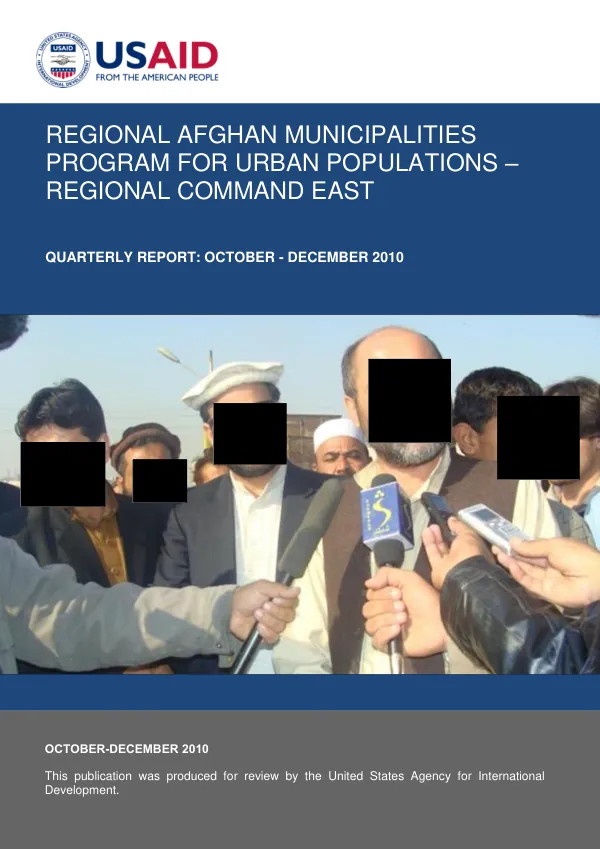
RAMP-UP EAST SECOND QUARTERLY REPORT
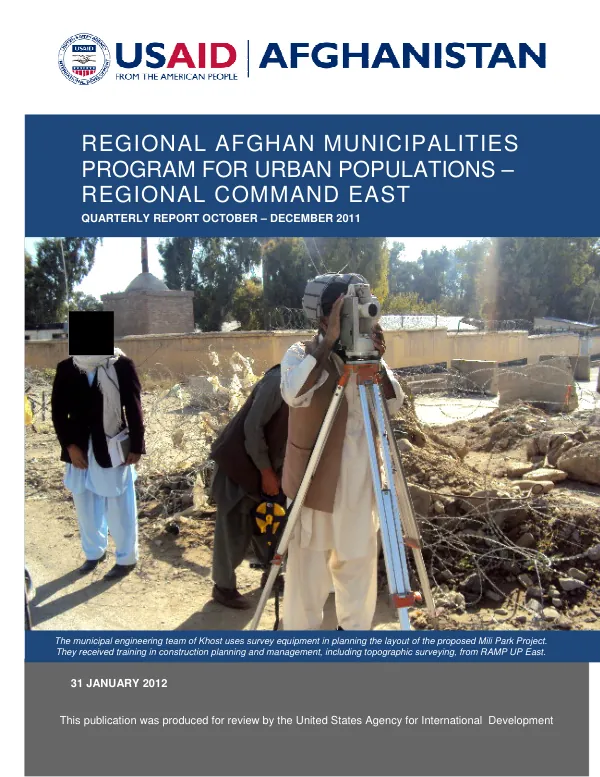
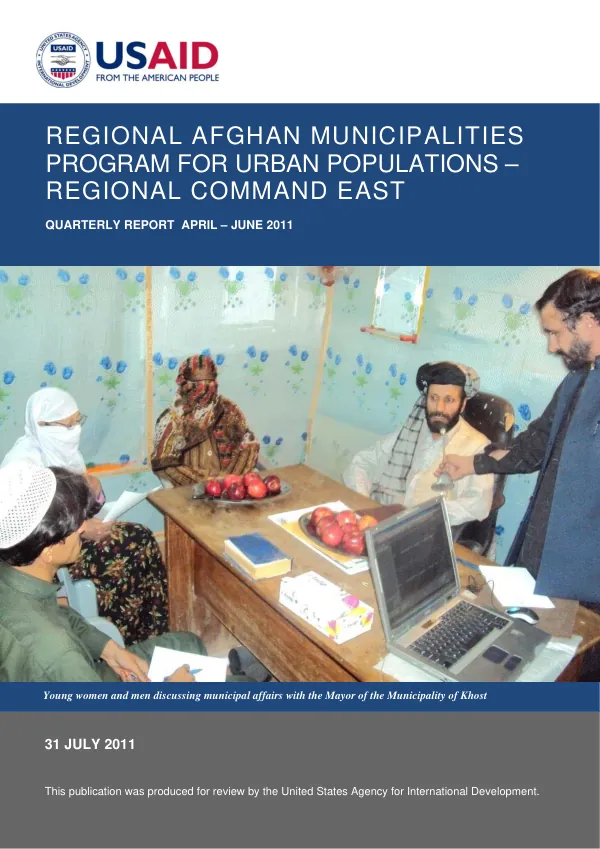
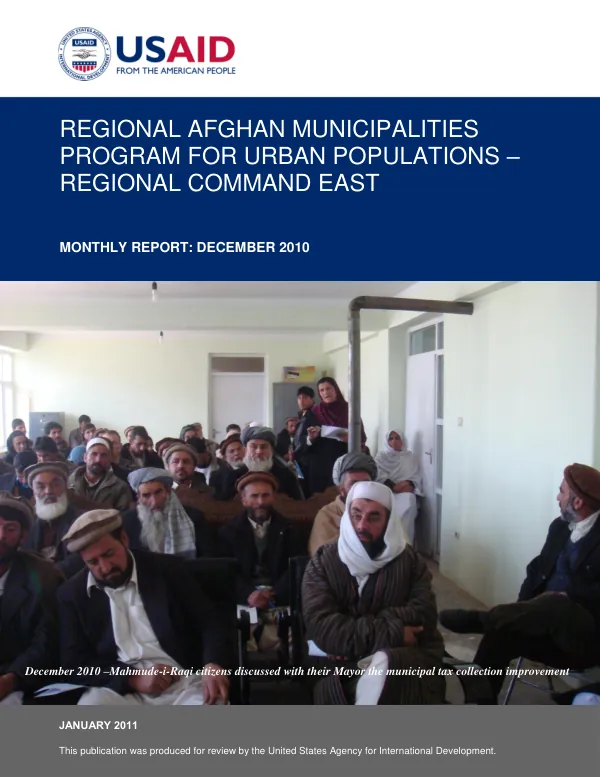
The Regional Afghan Municipalities Program for Urban Populations, Regional Command East (RAMP UP East) was initiated in June 2010 with the objective of creating effective, responsive, democratic, transparent, and accountable municipal governance in the 14 provinces within the International Security Assistance Force's (ISAF) Regional Command East.
2010 · 33 pages
Sign in to readA free account is required to download.
Abstract
The program comprises three distinct components, each tied to a specific goal. Component 1 focuses on capacity building of GIRoA officials at the municipal level, enhancing their skills, capabilities, and knowledge to perform their core municipal management responsibilities. This is achieved through a combination of on-the-job mentorship, training, and advising. Component 2 supports the GIRoA in providing responsive, effective, and visible municipal service delivery programs, enabling municipalities to deliver visible, tangible, and desirable services to citizens. Component 3 supports the GIRoA to improve economic development and revenue generation at the municipal level, strengthening the municipality's ability to finance its public services and operating costs. RAMP UP East works in all 14 provincial capitals, excluding Kabul city, in the provinces comprising ISAF Regional Command East. Nine of the 14 target municipalities are located within Key Terrain Districts, as defined by the U.S. Government, ISAF, and the GIRoA in the April 2010 Report on Progress Toward Security and Stability in Afghanistan. Key Terrain Districts are those where the bulk of the population is concentrated, and that contain centers of economic productivity, key infrastructure, and key commerce routes connecting such areas to each other and to the outside world. The overall objective of RAMP UP East has three expected outcomes: increasing the capacity of GIRoA municipal officials, markedly improving the delivery of municipal services to citizens in target municipalities, and increasing municipal capacity to enable, support, and sustain economic growth. RAMP UP East's impact is measured by the degree to which Afghan citizens see local governance structures as legitimate, which is tied to receiving better services, understanding the responsibilities of municipal leaders, and playing an active role in municipal decision making. The RAMP UP East team is guided by six primary principles that are applied throughout all program activities. These principles include Afghan Ownership, Afghan First, Demand Driven, Long-term Capacity of GIRoA, GIRoA Empowerment, and Learning-by-Doing. The program's approach emphasizes the importance of data collection, measurements, and documentation to ensure outputs, outcomes, and impacts are clearly documented and duly analyzed. RAMP UP East's implementation focuses on institutional development of municipalities in the long term while helping the municipalities deliver specific outcomes in the short term. The program's assistance is deployed at the Kabul and sub-national levels in accordance with the needs of the IDLG and the municipalities in which it works. RAMP UP East will report to both the GIRoA and USAID on the impact of its work, with all reports submitted to USAID shared with the IDLG and GIRoA institutions that will be the lead voice to guide programmatic activities. The program's activities under Component 1 and 2 strengthen municipal capacity and service delivery, while activities under Component 3 use the developed capacity, service improvements, and infrastructure to facilitate business growth and job creation. RAMP UP East's outcomes and impact are expected to contribute to a stronger revenue base, enabling a government to more effectively sustain, and potentially expand and improve, essential services.
Related documents