USAID DEC
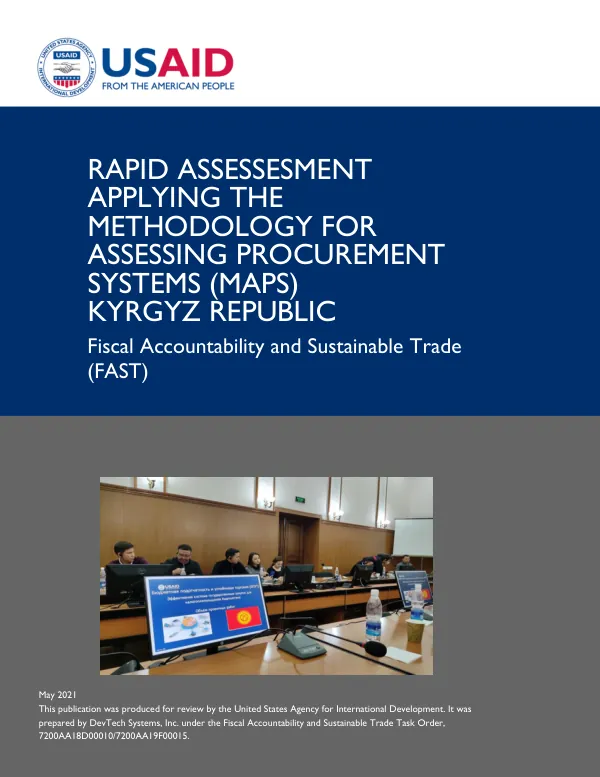
Rapid Assessment Report Using MAPS Methodology: Fiscal Accountability and Sustainable Trade (FAST) Task 6: Effective Public Procurement for Kyrgyzstani Taxpayers, MAPS Assessment, April 2021
Sign inDEVTECH SYSTEMS, INC.
Rapid Assessment Report Using MAPS Methodology: Fiscal Accountability and Sustainable Trade (FAST) Task 6: Effective Public Procurement for Kyrgyzstani Taxpayers, MAPS Assessment, April 2021
The Fiscal Accountability and Sustainable Trade (FAST) project, implemented by the U.S.
2021 · 139 pages
Sign in to readA free account is required to download.
Abstract
Agency for International Development (USAID), aims to improve the self-reliance of the Kyrgyz Republic by enhancing public procurement systems. The project seeks to reform systems and processes to increase efficiency, transparency, and civic engagement in public procurement operations. A rapid assessment was conducted using the Methodology for Assessing Procurement Systems (MAPS) to identify strengths and weaknesses of the public procurement system in the Kyrgyz Republic. The legal and regulatory framework for public procurement in the Kyrgyz Republic is publicly accessible, adequately recorded, and organized hierarchically with clear precedence. However, there are several regulations that supplement the procurement law but are not consolidated into a single comprehensive document. Additionally, the country has not yet adopted a Sustainable Public Procurement (SPP) Policy, and SPP considerations are not incorporated into procurement practice. The procurement planning process is guided by the e-portal, which requires a procurement plan to be in place and funds to be available before proceeding with solicitation. However, the commitment of budget funds for planned procurement in the Financial Management Information System is a manual process. The Department of Public Procurement (DPP), part of the Ministry of Economy and Finance, is responsible for the public procurement normative and regulatory function. The DPP is an independent legal entity led by a director appointed by the Prime Minister, but its staffing level is inadequate for its responsibilities. Public procurement is conducted in the e-portal, and the information therein is accessible in real time and at no cost. However, the information on the e-portal does not include details on contracts, contract amendments, completion reports, and payments. The DPP has largely been dependent on the support from development partners to implement improvements and upgrades to the system. The level of training on public procurement is basic and inadequate to ensure that responsible staff in procuring entities have appropriate knowledge, skills, and competencies. The institutional arrangements, duties, and responsibilities, and accountabilities of procuring entities are clearly defined. However, the country has not taken advantage of the opportunities afforded by implementing centralized procurement arrangements, although there are plans to undertake such initiatives. The public procurement system in the Kyrgyz Republic faces several challenges, including inadequate staffing, lack of training, and limited capacity to implement improvements and upgrades to the system.
Related documents