DEVTECH SYSTEMS, INC.
Strengthening Public Procurement Systems: International Best Practice
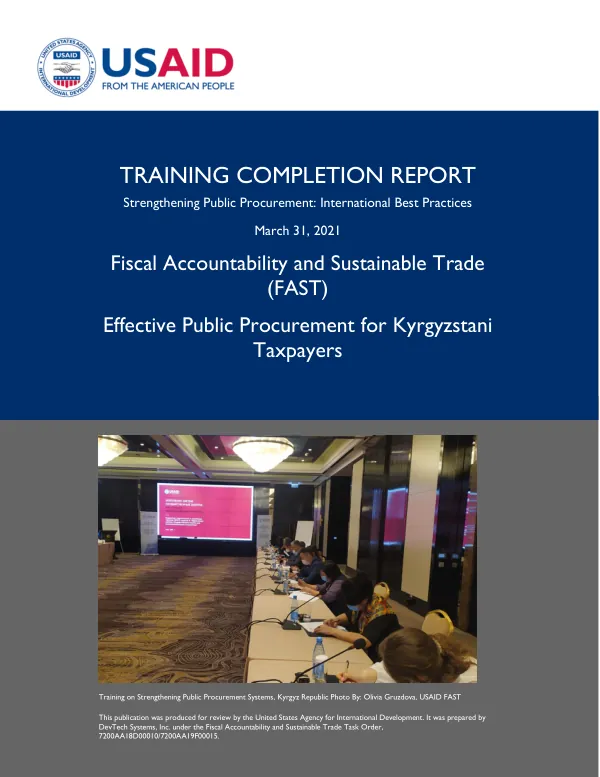
The one-day training on "Strengthening Public Procurement Systems: International Best Practice" was held on March 31, 2021, in the conference hall of the Hyatt Regency Hotel in Bishkek, Kyrgyz Republic.
2021 · 10 pages
Sign in to readA free account is required to download.
Abstract
The training was organized under the project "Fiscal Accountability and Sustainable Trade (FAST) Task 6: Effective Public Procurement for Kyrgyzstani Taxpayers." The objectives of the training were to introduce participants to international tools and standards relating to public procurement systems and examine the elements of a procurement system according to best practice, as well as in the context of the Kyrgyz Republic. The training course was attended by 28 leading procurement specialists from the branches of the Ministry of Economy and Finance of the Kyrgyz Republic. The participants were introduced to research findings regarding the stages of development of public procurement systems, starting from compliance and transaction efficiency as the lowest stages and leading to value chain orientation of the most mature procurement systems. They were presented with a case study that exemplified various aspects of more mature systems, including supporting local economic development, supplier development, and procurement at the front line of policy delivery. The participants were divided into five groups to discuss at what stage of development they believed the procurement system of the Kyrgyz Republic was and why. They were also introduced to the Methodology for Assessment of Public Procurement Systems (MAPS), the Transparent Public Procurement Rating (TPPR), and the UNCITRAL Model Law on Public Procurement. The training focused on the six building blocks of a public procurement system: the legal and regulatory framework, institutional framework, the procurement profession, the procurement marketplace, accountability and control, and transparency and integrity. The participants' survey results showed significant improvements in learning outcomes. The MAPS Assessment methodology and the UNCITRAL Model Law showed considerable improvement, along with the essential elements of a legal and regulatory framework, and the professionalization of public procurement. The learning score improved significantly, with "fully correct" responses increasing from 11 percent to 26 percent, and "partially correct" responses increasing from 33 percent to 42 percent. The participants provided positive feedback about the training, stating that they liked the training and achieved their goals. They suggested that future trainings should include information about green procurement and the experience of other countries, and that similar trainings should be conducted in the regions. The training was designed and conducted by procurement specialists from the FAST Task 6 project team, and it was attended by leading procurement specialists from the branches of the Ministry of Economy and Finance of the Kyrgyz Republic. The training aimed to improve the efficiency of procurement processes, increase the effectiveness of public procurement, and better utilize taxpayer money. Implementing the reforms will help to elevate public procurement to professional status, and the participants will be better equipped to support further procurement reforms. The training was a step towards strengthening public procurement systems in the Kyrgyz Republic, and it will contribute to the country's economic development and growth.
Related documents