USAID DEC
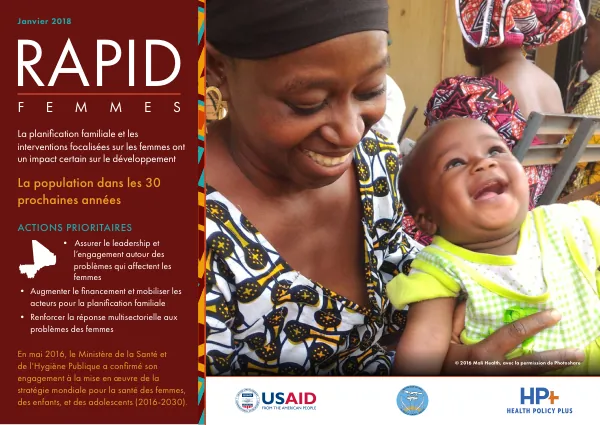
RAPID Femmes Infographiques
The Malian government has committed to implementing the global strategy for women's, children's, and adolescents' health from 2016 to 2030.
2018 · 2 pages
Sign in to readA free account is required to download.
Abstract
This initiative aims to reduce maternal, neonatal, infant, and juvenile mortality rates, contribute to socio-economic and political development through girls' education and women's literacy, and involve all stakeholders inclusively. The combination of family planning and women-centered strategies is expected to improve Mali's ranking from 167th to 117th out of 169 countries by 2050. Investing in women's and girls' autonomy will contribute to improved health and economic well-being for all Malians. In Mali, six out of ten women have never attended school, and one woman gives birth to six children on average during her lifetime. Approximately four out of ten women have experienced physical violence since the age of 15. The country's population is growing rapidly, with a projected increase from 15 million in 2010 to 57 million in 2050. In rural areas, only 5.1% of married women use any form of family planning. The population growth scenario with a combination of three components - family planning, girls' education, and gender norms change - projects a population of 33 million by 2050. Investing in women and girls is expected to prevent over 100,000 maternal deaths and more than seven million infant and juvenile deaths. Key strategies to address these challenges include improving the use of quality family planning services, increasing women's and girls' education levels, enhancing girls' knowledge of reproductive health and family planning, and ensuring better awareness of gender-based violence. Additionally, maintaining girls in school, improving women's and girls' economic power and status, and reinforcing the maintenance of girls in education are crucial steps towards achieving these goals.
Related documents