USAID DEC
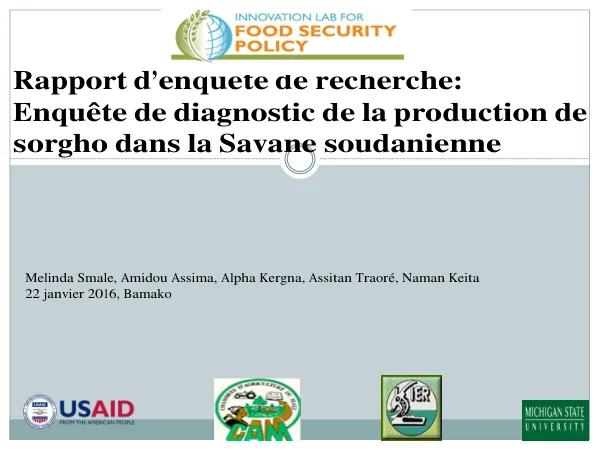
Rapport d’enquête de recherche: Enquête de diagnostic de la production de sorgho dans la Savane soudanienne
Sign inUSAID DEC
Rapport d’enquête de recherche: Enquête de diagnostic de la production de sorgho dans la Savane soudanienne
The agricultural development initiative in the Savane soudanienne region of Mali began with a research diagnostic survey to assess sorgho production.
2016 · 20 pages
Sign in to readA free account is required to download.
Abstract
The study aimed to measure the adoption rates of sorgho ecotypes and the use of seeds and fertilizers. It also sought to test data collection methods, form a reliable research team, and develop a database on sorgho and maize production in the region. The study area consisted of 58 villages, with 628 family-owned agricultural operations and 1,382 sorgho and maize parcels surveyed. The population of the region was predominantly rural, with a significant proportion of women-headed households. The average age of the farm managers was 52.9 years, with a range of 22 to 107 years. The study found that the majority of farmers practiced pure sorgho cultivation, with 79.59% of parcels dedicated to this crop. Sorgho was the primary crop, followed by maize, rice, and other cereals. The average area cultivated per farm was 2.16 hectares, with a range of 0.59 to 3.04 hectares. The majority of farmers used local sorgho varieties, with 1626 parcels surveyed using these varieties. The study also found that the average area cultivated per farm increased over time, with a significant increase in the use of hybrid sorgho varieties. The average area cultivated per farm using hybrid sorgho varieties increased from 0.615 hectares in 2009 to 1.59 hectares in 2013. The use of improved sorgho varieties also increased, with an average area cultivated per farm increasing from 1.59 hectares in 2009 to 2.24 hectares in 2013. The study's findings have implications for agricultural development initiatives in the region. The high adoption rates of sorgho ecotypes and the use of seeds and fertilizers suggest that farmers are responsive to new technologies and practices. However, the study also highlights the need for further research on the impact of these technologies on farm productivity and household income. The study's database on sorgho and maize production in the region provides a valuable resource for policymakers and researchers seeking to understand the dynamics of agricultural production in the Savane soudanienne region.