USAID DEC
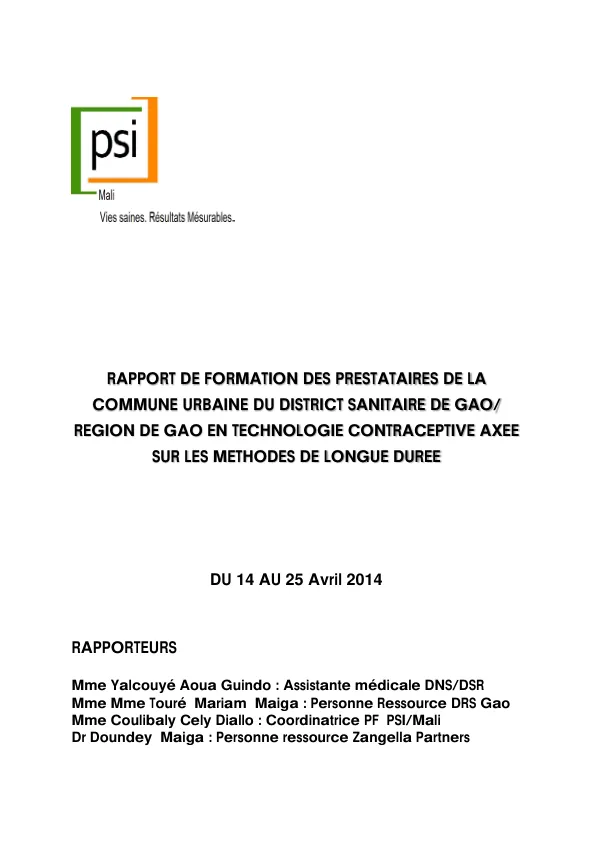
Rapport de formation des prestataires de la Commune urbaine du District Sanitaire de Gao en technologie contraceptive axée sur les méthodes de longue durée
Sign inPSI
Rapport de formation des prestataires de la Commune urbaine du District Sanitaire de Gao en technologie contraceptive axée sur les méthodes de longue durée
The training of service providers in the Commune Urbaine of Gao, District Sanitaire of Gao, in Technology Contraceptive Axée sur les Méthodes de Longue Durée took place from April 14 to 25, 2014, at the Ecole des Infirmiers de Gao.
2014 · 36 pages
Sign in to readA free account is required to download.
Abstract
This training session was part of the partnership between PSI and Zangella Partners at the district level of Gao in collaboration with the DRS. The opening and closing ceremonies were presided over by the Regional Director of Health, who welcomed the participants, placed the training in context, and exhorted them to be diligent and participatory. The participants came from the following structures: Hôpital de Gao (3), Csref de Gao (2), Cscom de Wabaria (2), Cscom de Boulgoundjé (2), Cscom de Gadeye (2), Cscom de Chateau (2), Cscom de Bagoundjé (1), Cscom de Aljanabandia (2), Cscom de Berrah (2), Cscom de Sossokoira (2), and AMPPF (3). The main purpose of the training was to develop and/or reinforce the skills of service providers in family planning services, in order to provide clients with high-quality services, effective counseling on the use of contraceptive methods in complete safety. The overall objective was to train 23 service providers from the Commune Urbaine of Gao in family planning, focusing on long-term methods. The methodology used was active, with the following techniques: illustrated lectures, group discussions, group work, role-playing, simulation, brainstorming, question-and-answer sessions, and demonstrations on anatomical models. The evaluation consisted of a pre-questionnaire, practical evaluation, and a mid-term and final questionnaire. The acceptable level of knowledge required was set at 80%, and the acceptable level of performance required was also set at 80%. The tools used were learning sheets, certification of competence lists, and pre- and post-test questionnaires. The training lasted 11 days, with six days of theoretical courses and five days of practical training on four sites. The different themes presented were: the concept of reproductive health, anatomy and physiology of reproduction, generalities on family planning, prevention of infections, communication, quality assurance, and reference systems in case of complications. The participants were divided into four sites for practical training. The results of the training showed that the pre-questionnaire had the lowest score of 17, with 61%, and the highest score of 28, with 78%. The mid-term and final questionnaire showed a score of 30, with 83%, and the highest score of 35, with 97%. A total of 23 service providers were trained in long-term methods, including three from the AMPPF. In conclusion, the analysis of the results of the different evaluations showed that the clients had more enthusiasm for Jadelle than for DIU, as attested by the results of the training (116 cases of Jadelle insertion against 1 case of DIU insertion). The number of DIU insertions required was not achieved by any of the participants, which justified their non-certification. Overall, the training was satisfactory, as all the objectives were achieved. Recommendations were made to improve future results, including: programming and executing immediate and regular follow-up of trained service providers, extending the training to other structures in the region, providing food to the training sites instead of giving money to the participants, and training service providers on cervical cancer screening.
Related documents