USAID DEC
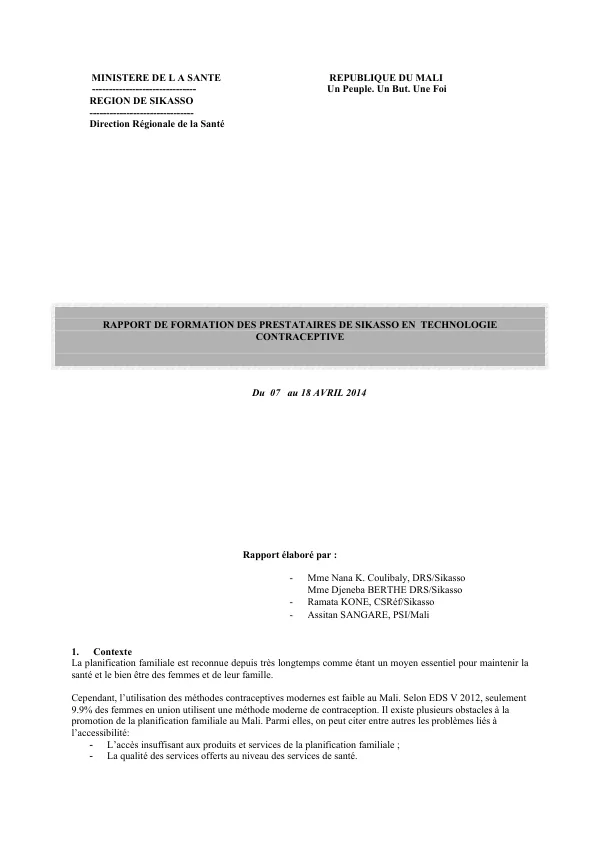
Rapport de Formation des Prestataires de Sikasso en Technologie Contraceptive
The Ministry of Health of the Republic of Mali, in collaboration with PSI/Mali, organized a training program for healthcare providers in Sikasso region on contraceptive technology.
2014 · 19 pages
Sign in to readA free account is required to download.
Abstract
The training took place from April 7 to 18, 2014, at the Maissa hotel conference room. The objective of the training was to develop and strengthen the skills of healthcare providers in providing family planning services, counseling, and prescribing contraceptive methods safely. The training program was designed to cover two modules: communication interpersonnel/Counseling and elements of contraceptive technology. The first module included chapters on approach to clinical formation, concept of reproductive health, anatomy and physiology of reproduction, communication, generalities on counseling, and client acceptance in reproductive health services. The second module covered chapters on generalities on family planning, generalities on contraceptive methods, natural methods of contraception, and various types of contraceptive methods. The training methodology was participatory, using techniques such as presentations, brainstorming, role-playing, simulations, demonstrations on anatomical models, group work, case studies, and practical exercises. The training materials included models of the female reproductive system, a penis model, samples of all family planning methods, technical materials for inserting and removing intrauterine devices (IUDs) and implants, and a manual on reproductive health. The training program was facilitated by four individuals, including two medical assistants from the Regional Directorate of Health, a midwife from the Regional Health Reference Center, and a family planning supervisor from PSI. The participants consisted of 25 healthcare providers from Sikasso and Bamako, including four district health teams and five healthcare providers from private clinics. The training program was divided into two phases: theoretical and practical. The theoretical phase covered the two modules, with each module based on educational objectives, content, methods, and pedagogical tools to facilitate learning. The practical phase consisted of four morning sessions, focusing on inserting and removing IUDs and implants, initial, specific, and follow-up counseling, and managing side effects. The training program also included a pre-test to evaluate the participants' knowledge, a mid-test and final test to evaluate their knowledge, and a certification of competence in counseling, prescribing methods, preventing infections, and double protection. At the end of the training program, the participants evaluated the pedagogical and administrative aspects of the program. A manual on reproductive health was provided to all participants, and an attestation of competence would be awarded to participants who acquired the required level of knowledge after completing five insertions and five removals of Jadelle and IUDs on real cases.
Related documents