ABT ASSOCIATES
Health Finance and Governance (HFG) Project Final Report (2012-2018)
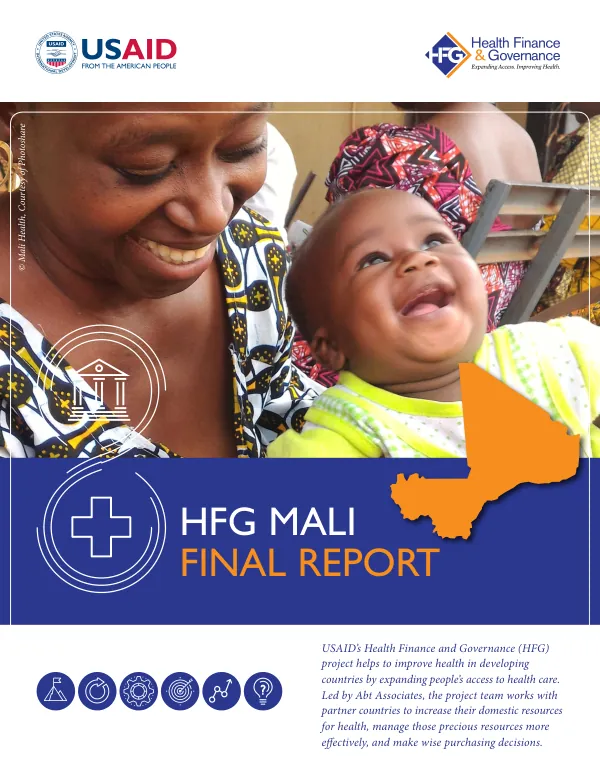
The Health Finance and Governance (HFG) project in Mali aimed to improve the country's health system by increasing domestic resources for health, managing those resources more effectively, and making wise purchasing decisions.
2018 · 12 pages
Sign in to readA free account is required to download.
Abstract
Led by Abt Associates, the project team collaborated with the Ministry of Health and Public Hygiene (MHPH) to address the country's health challenges. Mali had made significant progress in reducing under-five and infant mortality rates in the previous decade, but progress was hindered by internal security issues, displaced populations, and overburdened health structures. A lack of up-to-date information on health system performance and gaps impeded the government's ability to make strategic decisions and strengthen the health system. The MHPH requested HFG's assistance to generate information on the health system, with a focus on health financing and the private sector. HFG convened and consulted technical and financing partners, the private sector for health, and government stakeholders at national and subnational levels to contribute to generating and using information to make strategic decisions and strengthen the health system. After three years of HFG's technical assistance, the MHPH had critical information on the strengths and challenges of each health building block, information on health spending and on the private sector to help prioritize health interventions, improved planning, and sound allocation of health investment. HFG's activities helped inform more technical in-depth and evidence-based discussions around efforts to strengthen health system performance, resulting in changes that are paving the way for a positive impact on the health status of Malians. Key results over the past three years include strengthening the management capacity of the Secretary General's office within the MHPH, building consensus on health system priorities and challenges among national and subnational stakeholders, improving the MHPH's capacity to use health financing data for decision-making, and increasing engagement between the public and private health sectors. The management assessment conducted by HFG provided recommendations for improving the efficiency and effectiveness of the MHPH Secretary General's office. The office oversees the planning, organization, coordination, and management of the MHPH, but lacked the staff to handle a significant workload. Findings from the assessment increased ministry leaders' awareness of the heavy burden of work on a small staff, insufficient coordination among technical advisors, a large backlog of work on critical health programs, and weak coordination among partners. The MHPH leadership decided to assign three technical advisors to the Secretary General's office, demonstrating the office's confidence in the management assessment findings and strong engagement in applying the recommendations. Having a larger team in the office has improved the MHPH's ability to make timely and strategic decisions on important health issues and has helped remove bottlenecks in the delivery of vital health services. HFG also conducted a comprehensive health systems assessment (HSA) to assess health system strengths, challenges, and opportunities. The HSA is organized around WHO's six building blocks of the health system: leadership/governance, financing, service delivery, human resources, medical products, vaccines and technologies, and health information systems. The resulting HSA report identified major strengths, weaknesses, and general recommendations for each building block in Mali. The project's results have made a significant difference in Mali's health system. The MHPH has successfully increased the number of technical advisors by three additional staff to alleviate the workload and augment the efficiency of the General Secretariat functioning. This was a major achievement, as stated by Sidi Cisse, Senior Health Policy Advisor, USAID Mali.