USAID DEC
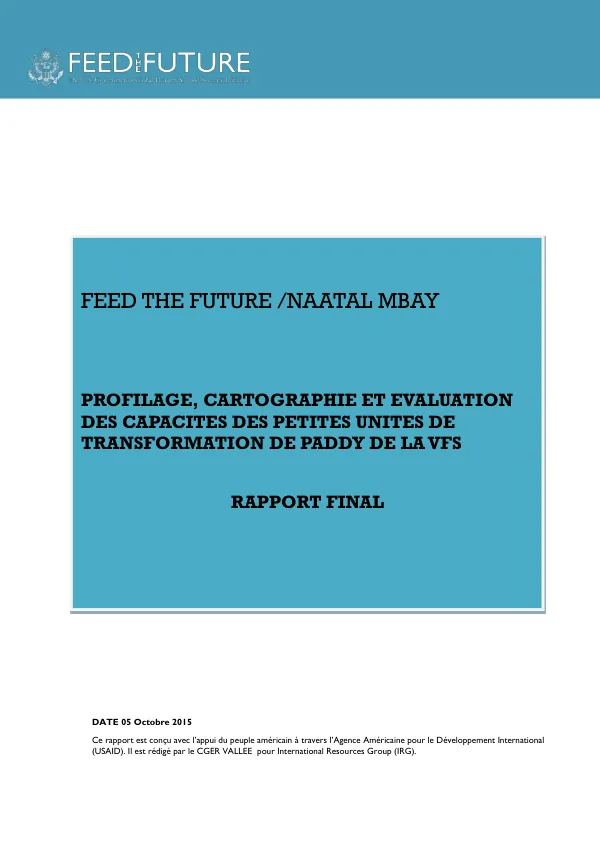
Rapport Final: Profilage, Cartographie et Évaluation des Capacités des Petites Unités de Transformation de Paddy de la VFS
Sign inINTERNATIONAL RESOURCES GROUP
Rapport Final: Profilage, Cartographie et Évaluation des Capacités des Petites Unités de Transformation de Paddy de la VFS
The agricultural development initiative in Senegal, specifically in the Naatal Mbay region, began in 2015 with funding from USAID's Feed the Future program.
2015 · 61 pages
Sign in to readA free account is required to download.
Abstract
The initiative aimed to improve the capacity of small rice processing units in the region. The study was conducted by the CGERV (Centre de Coordination des Centres de Gestion et d'Economie Rurale de la Vallée du Fleuve Sénégal) for International Resources Group (IRG). The study focused on the typology of small rice processing units, their characteristics, and the constraints they face. The units were classified into three categories based on the type and state of their machines. The study found that the majority of units were small-scale, with limited capacity for processing and storage. The units were also found to have limited access to credit and markets, which hindered their development. The study also examined the characteristics of the units, including their production capacity, storage capacity, and market access. The results showed that the units had limited capacity for processing and storage, and that they relied heavily on manual labor. The study also found that the units had limited access to credit and markets, which hindered their development. The study identified several constraints to the development of the small rice processing units, including limited access to credit, markets, and technology. The study recommended several solutions to address these constraints, including the provision of credit and training to unit owners, the establishment of a market information system, and the introduction of new technologies to improve processing efficiency. The study also examined the role of women in the small rice processing units. The results showed that women played a significant role in the units, particularly in the processing and storage of rice. However, the study also found that women faced several challenges, including limited access to credit and markets, and limited training and technical support. The study concluded that the small rice processing units in the Naatal Mbay region faced several challenges that hindered their development. However, the study also identified several opportunities for improvement, including the provision of credit and training to unit owners, the establishment of a market information system, and the introduction of new technologies to improve processing efficiency. The study recommended several actions to address the challenges faced by the small rice processing units, including: * Providing credit and training to unit owners to improve their capacity for processing and storage * Establishing a market information system to improve market access and prices * Introducing new technologies to improve processing efficiency and reduce labor costs * Providing technical support and training to unit owners to improve their skills and knowledge * Encouraging women's participation in the units and providing them with training and technical support. The study also recommended that the government and other stakeholders take several actions to support the development of the small rice processing units, including: * Providing credit and subsidies to unit owners to improve their capacity for processing and storage Overall, the study provided valuable insights into the challenges faced by the small rice processing units in the Naatal Mbay region and identified several opportunities for improvement. The study's recommendations provide a roadmap for addressing the challenges faced by the units and improving their capacity for processing and storage.