USAID DEC
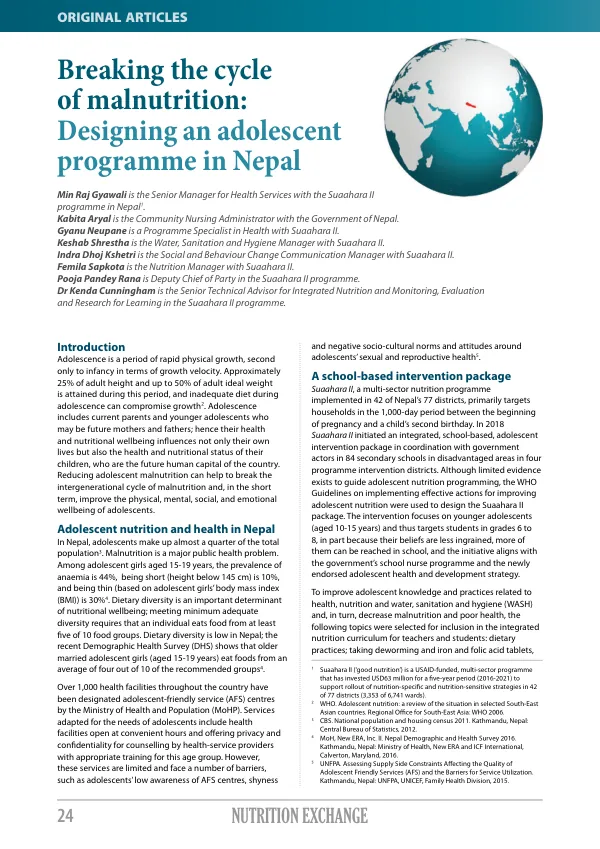
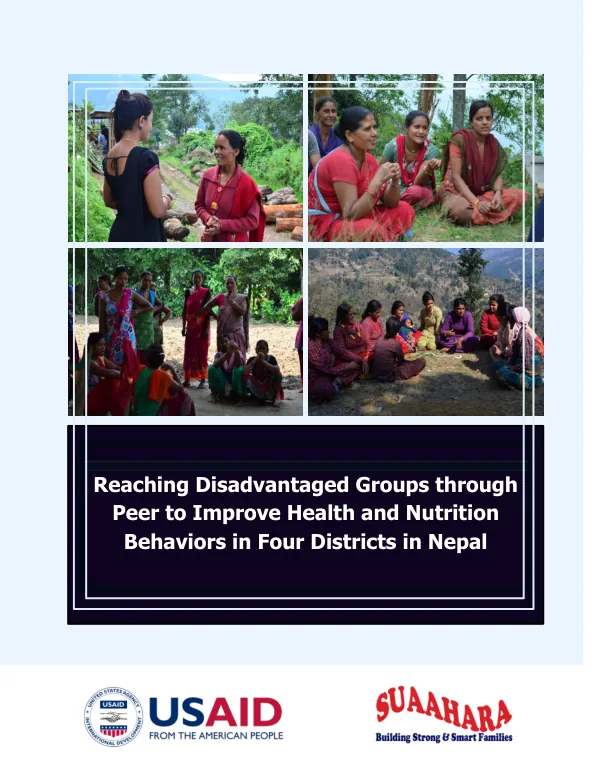
Reaching Disadvantaged Groups through Peer to Improve Health and Nutrition Behaviors in Four Districts in Nepal
Sign inSAVE THE CHILDREN FUND
Reaching Disadvantaged Groups through Peer to Improve Health and Nutrition Behaviors in Four Districts in Nepal
The Suaahara program, implemented by Save the Children, aimed to improve health and nutrition behaviors among women and children in four districts in Nepal.
2015 · 55 pages
Sign in to readA free account is required to download.
Abstract
The program focused on disadvantaged groups, particularly in DAG VDCs, and was conducted in collaboration with the Valley Research Group. The study was carried out to assess the effect of mobilizing peers on improving health and nutrition behavior among the target population. The study was conducted in 2014 and 2015, with a total of 1890 mothers (945 from intervention and 945 from comparison areas) included in each round of survey. The study team consisted of Shailes Neupane as the Team Leader, Yogendra Pradhananga, Saurav Neupane, and Mahesh Kumar Puri as Team Members, and Bishnu Hari Devkota, Sachin Koirala, Laxman Neupane, and Bimala Maharjan as Office Support. Field Supervisors and Interviewers included Balchandra Devkota, Indira Khapangi Magar, Balkrishna Sharma, Jamuna Parajuli, Bhim Neupane, Krishna Chaudhary, Buddhiman Thapa, Krishna Kharel, Chitra Mani Neupane, Mamata Mishra, Jaya Karan Shah, Nilam Rai, Khadga Raj Kharel, Pramila Rai, Nabaraj Ghimire, Ranjana Bhattarai, Rajendra Panthi, Reeta Bhattarai, Umesh Shahi, Reetu Shah, Anjana Dulal, Salina Shah, Chhuke Shrepa, Sanita Sainju, Anu Adhikari, Sita Rimal, Aruna Dulal, Sudina Maharjan, Bhagawati Adhikari, Sumitra Timilsina, Durga Pudasaini, Sushila Bhujel, Durga Sanjel, and Sushila Khadka. The study collected data on socio-demographic characteristics, housing conditions, household possessions, water and sanitation, IYCF knowledge and practices, maternal health and nutrition knowledge and practices, exposure to peer facilitators, and other relevant indicators. The data was analyzed to assess the impact of the Suaahara program on the target population. The study found that the Suaahara program had a positive impact on the target population, particularly in terms of IYCF knowledge and practices, maternal health and nutrition knowledge and practices, and exposure to peer facilitators. The program also showed a significant improvement in the socio-economic status of the target population, with increased access to healthcare services, improved housing conditions, and increased household possessions. The study concluded that the Suaahara program was effective in improving health and nutrition behaviors among women and children in the target population. The program's focus on mobilizing peers and providing support to disadvantaged groups was found to be an effective strategy in improving health and nutrition outcomes. The study recommended that the Suaahara program be scaled up to reach more communities and that the program's strategies be replicated in other areas to improve health and nutrition outcomes. The study also highlighted the importance of continued support and encouragement from government and non-government agencies, as well as the need for further research to assess the long-term impact of the program. The study's findings and recommendations are expected to inform policy and program decisions aimed at improving health and nutrition outcomes in Nepal.