USAID DEC
MaMoni Program Brief: Integrating Management of Severe Acute Malnutrition into the Bangladesh Public Health System
Sign inGOVERNMENT OF BANGLADESH
MaMoni Program Brief: Integrating Management of Severe Acute Malnutrition into the Bangladesh Public Health System
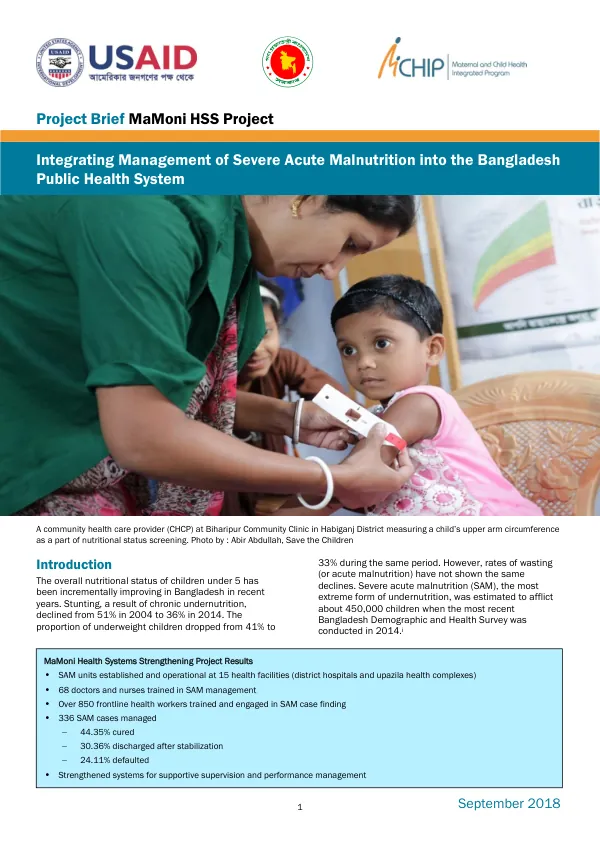
The MaMoni Health Systems Strengthening Project was implemented in Bangladesh to integrate the management of severe acute malnutrition (SAM) into the public health system.
2018 · 8 pages
Sign in to readA free account is required to download.
Abstract
The project was funded by the United States Agency for International Development and supported the Ministry of Health and Family Welfare to establish SAM units at 15 health facilities across four focus districts. The project's goal was to strengthen the health system's capacity to manage SAM cases, particularly in rural areas where access to healthcare is limited. The project's intervention included the establishment of SAM units at district hospitals and upazila health complexes, training of frontline health workers to identify and refer SAM cases, and provision of nutritional counseling for pregnant and lactating women. The project also provided community clinics and union-level facilities with informational materials on nutrition, including MUAC, height/length, and weight measurement tools. A total of 65 medical providers and over 850 frontline health workers were trained in SAM management, and 336 SAM cases were managed during the project period. The project also established a memorandum of understanding with the Institute of Public Health Nutrition to support the implementation of the national nutrition program. The project's support included the provision of basic essentials, a SAM management flowchart, copies of the national SAM guidelines, and therapeutic foods F-75 and F-100 to the SAM units. The project's results showed that 44.35% of SAM cases were cured, 30.36% were discharged after stabilization, and 24.11% defaulted. The project also strengthened the systems for supportive supervision and performance management. The project's findings highlighted the importance of community-level case identification and management in reducing mortality and improving the coverage of nutrition programs. The project's approach to SAM management was based on the 10-step SAM management protocol, which includes steps such as treating/preventing hypoglycemia, treating/preventing hypothermia, and correcting electrolyte imbalance. The project also provided training and supplies to the staff of each facility's outpatient Integrated Management of Childhood Illness (IMCI) corner to facilitate the integration of growth monitoring and rapid SAM case identification into the facilities' IMCI services. The project's findings and recommendations have implications for the national nutrition program and the health system's capacity to manage SAM cases in Bangladesh.
Related documents
![Bangladesh Health Facility Survey 2017 [SPA28]](https://covers.devme.ai/gen/144484.webp)