USAID
READING KNOWLEDGE, SKILLS AND ATTITUDES (KSA) ASSESSMENT
The Reading Knowledge, Skills, and Attitudes (KSA) Assessment is a tool used to evaluate teachers' knowledge and practices related to reading instruction.
8 pages
Sign in to readA free account is required to download.
Abstract
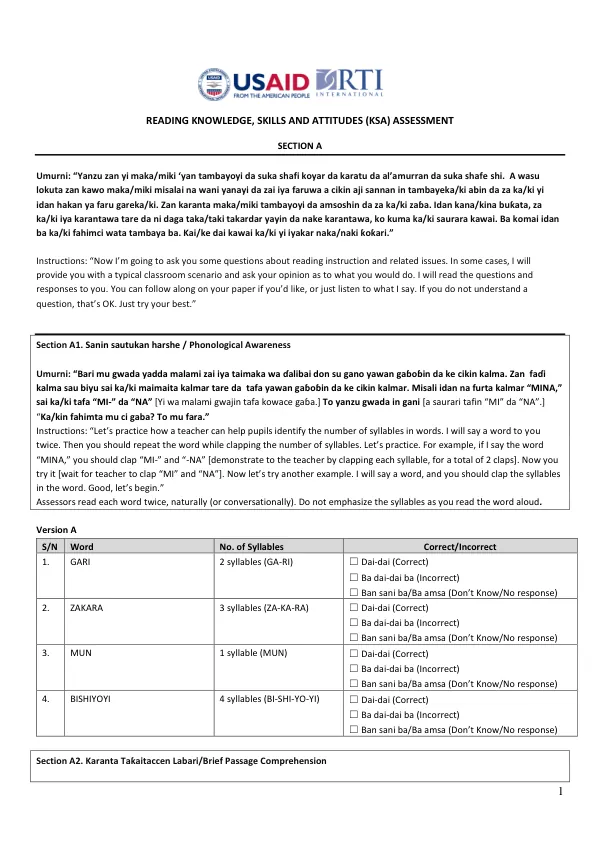
The assessment consists of two sections: Section A and Section B. Section A focuses on phonological awareness and brief passage comprehension. In this section, teachers are presented with a series of words and asked to identify the number of syllables in each word. The words are read aloud twice, and the teacher is asked to repeat the word while clapping the number of syllables. The assessment also includes a brief passage comprehension task, where the teacher is asked to read a short story in Hausa and then identify the main idea of the passage. The results of the phonological awareness task show that the teacher is able to identify the number of syllables in most of the words, with some errors. The brief passage comprehension task reveals that the teacher is able to understand the main idea of the passage, but may struggle with some of the details. Section B focuses on reading instruction and related issues. In this section, teachers are presented with a series of statements related to reading and asked to identify the statement they agree with the most. The statements cover a range of topics, including the causes of reading difficulties, the role of parents in reading instruction, and the transfer of literacy skills from one language to another. The results of the reading instruction task show that the teacher holds a range of views on reading instruction, with some statements receiving more agreement than others. For example, the teacher agrees that many factors can cause a child to struggle to learn to read, and that illiterate parents can play an important role in helping their children learn to read. However, the teacher also agrees that reading words correctly is an important indicator of understanding, and that literacy skills in a child's first language can transfer to other languages. Overall, the Reading KSA Assessment provides a comprehensive picture of a teacher's knowledge and practices related to reading instruction. The assessment can be used to identify areas of strength and weakness, and to inform professional development and support for teachers. The assessment is designed to be administered in a way that is fair and valid for all teachers, regardless of their background or experience. The assessment is typically administered in a quiet and distraction-free environment, and the teacher is given the opportunity to read the statements and answer the questions at their own pace. The results of the assessment are typically scored using a rubric that takes into account the teacher's level of agreement with each statement. The scores are then used to inform professional development and support for the teacher, and to identify areas where the teacher may need additional training or support. In terms of the specific statements presented in the assessment, the results show that the teacher agrees with the following statements: * Many factors can cause a child to struggle to learn to read (Statement 6). * Illiterate parents can play an important role in helping their children learn to read (Statement 8). * Literacy skills in a child's first language can transfer to other languages (Statement 9). * Reading with expression is an important indicator of understanding (Statement 7). The teacher also agrees with the following statements, but to a lesser extent: * Reading words correctly is an important indicator of understanding (Statement 7). * Literacy skills in a child's first language only benefit the first language (Statement 9). The teacher does not agree with the following statements: * A child's lack of natural intelligence is the only reason they may struggle to learn to read (Statement 6). * Illiterate parents cannot assist their children to learn to read (Statement 8). * Reading with expression is the only indicator of understanding (Statement 7). Overall, the results of the assessment provide a comprehensive picture of the teacher's knowledge and practices related to reading instruction, and can be used to inform professional development and support for the teacher.