USAID
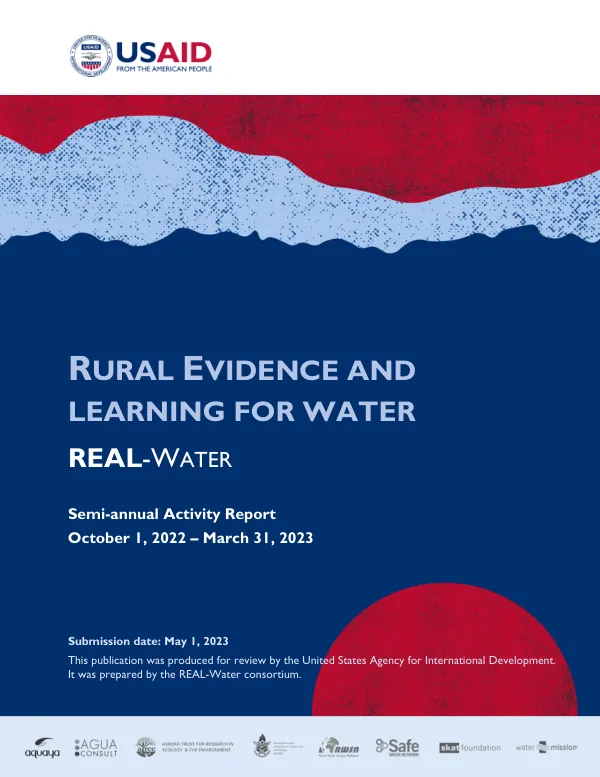
REAL-Water Semi-Annual Activity Report (October 2022–March 2023)
The Rural Evidence and Learning for Water (REAL-Water) program is an implementation research program dedicated to building the evidence base for achieving safe, equitable, sustainable rural water supplies in low- and middle-income countries.
2023 · 50 pages
Sign in to readA free account is required to download.
Abstract
REAL-Water is supported through a Cooperative Agreement between the United States Agency for International Development (USAID) and The Aquaya Institute (Aquaya). This knowledge-building initiative contributes to the goals of USAID's Water and Development Plan, established under the U.S. government's Global Water Strategy. The REAL-Water program comprises three interrelated components: implementation research, evidence for decision-making, and USAID WASH coordination. Implementation research applies scientific methods, international collaboration, and rigorous analyses to address critical water and development themes, including improving rural water management, strengthening water safety management, and improved planning for water resources. Implementation research is conducted through three research streams: Improving Rural Water Management (IMP), Strengthening Water Safety Management (WSM), and Improved Planning for Water Resources (WRM). Research Stream 1, IMP, focuses on improving rural water management through the development of evidence-based solutions. Research Stream 2, WSM, aims to strengthen water safety management by identifying and addressing water safety risks. Research Stream 3, WRM, focuses on improving planning for water resources through the development of evidence-based approaches. The REAL-Water program also conducts evidence for decision-making through the Advisory Board, which provides strategic guidance and oversight to the program. The Advisory Board comprises experts from various fields, including water, sanitation, and hygiene. The program also engages in global, strategic, and opportunistic engagement to share knowledge and best practices with stakeholders. In addition to implementation research and evidence for decision-making, the REAL-Water program is responsible for USAID WASH coordination. This involves working with USAID missions to provide technical assistance and support for water, sanitation, and hygiene programs. The program also monitors, evaluates, and learns from its activities to ensure that they are effective and efficient. The REAL-Water program has made significant progress in its first year, with key accomplishments including the development of evidence-based solutions for improving rural water management, strengthening water safety management, and improving planning for water resources. The program has also engaged with stakeholders through various events and activities, including public workshops, conferences, and online activities. The REAL-Water program has also made progress in its monitoring, evaluation, and learning activities, with results indicating that the program is on track to meet its objectives. The program has also made significant progress in its USAID WASH coordination activities, with technical assistance and support provided to USAID missions. The REAL-Water program is committed to building the evidence base for achieving safe, equitable, sustainable rural water supplies in low- and middle-income countries. The program will continue to conduct implementation research, evidence for decision-making, and USAID WASH coordination activities to achieve its objectives.
Related documents