UNITED STATES DEPARTMENT OF AGRICULTURE
REAP Helps Farmers Produce More Food from Fallow Land of Pond Dikes
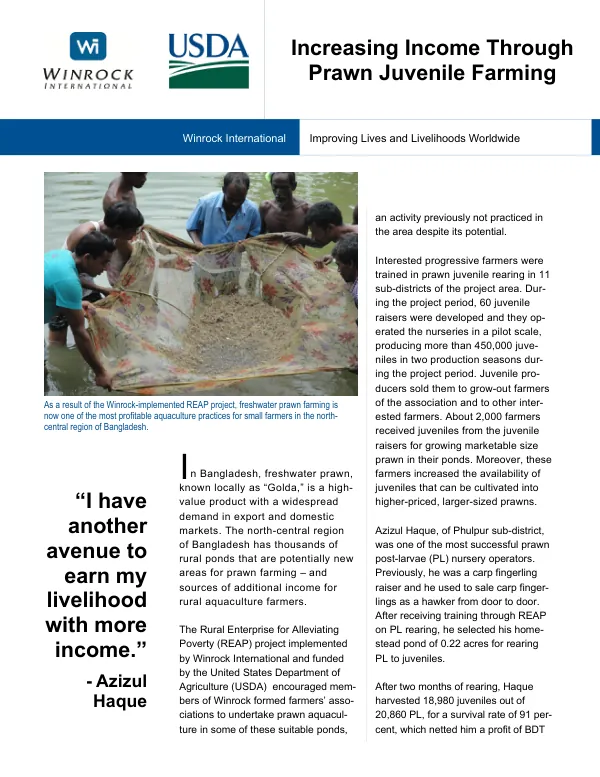
Winrock International, a nonprofit organization, implemented the Rural Enterprise for Alleviating Poverty (REAP) project in Bangladesh.
2011 · 2 pages
Sign in to readA free account is required to download.
Abstract
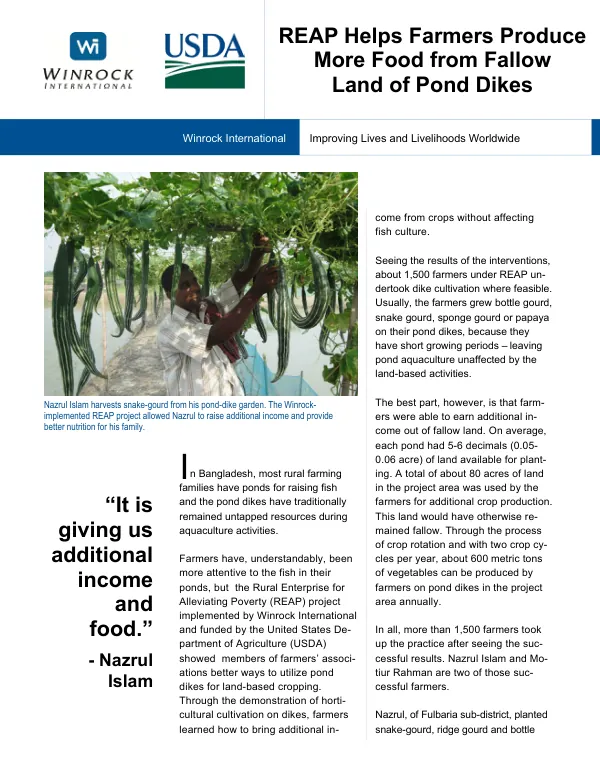
Funded by the United States Department of Agriculture (USDA), the project aimed to improve the livelihoods of rural farming families by utilizing pond dikes for land-based cropping. Traditionally, pond dikes remained untapped resources during aquaculture activities, with farmers focusing primarily on fish culture. Through the REAP project, farmers' associations were trained on horticultural cultivation on dikes, demonstrating the potential for additional income from crops without affecting fish culture. The project showed that crops such as bottle gourd, snake gourd, sponge gourd, and papaya could be grown on pond dikes, as they have short growing periods and do not interfere with aquaculture activities. Farmers were able to earn additional income from these crops, with each pond typically having 5-6 decimals (0.05-0.06 acre) of land available for planting. The project area saw a significant increase in vegetable production, with approximately 600 metric tons of vegetables produced annually on pond dikes. This was achieved through crop rotation and two crop cycles per year. The project's success led to over 1,500 farmers adopting the practice of growing crops on pond dikes. Farmers such as Nazrul Islam and Motiur Rahman, who participated in the project, reported significant increases in income and improved nutrition for their families. Nazrul Islam, a farmer from Fulbaria sub-district, planted snake-gourd, ridge gourd, and bottle gourd on his pond dike, producing 654 kilograms of snake and ridge gourd in a 2-month period. This earned him an additional income of BDT 12,470 (US$182) and provided better nutrition for his family. Motiur Rahman, a farmer from Gouripur sub-district, cultivated papaya on his pond dikes alongside prawn culture, producing 874 kilograms of papaya in a 5-month period. He earned BDT 10,743 (US$156) as supplemental income and used the extra income to improve the lives of his children. The REAP project demonstrated the potential for small farmers to earn supplemental income by utilizing previously fallow pond dikes for crop production. The project's success highlights the importance of sustainable agriculture practices and the need for innovative approaches to improve the livelihoods of rural farming families.