USAID DEC
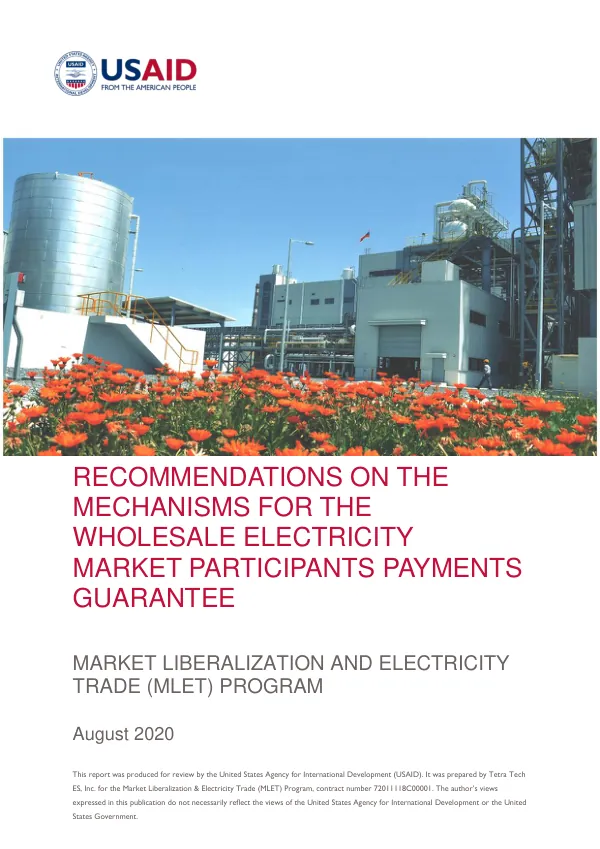
Recommendations on the Mechanisms for the Wholesale Electricity Market Participants Payments Guarantee
Sign inWORLD BANK
Recommendations on the Mechanisms for the Wholesale Electricity Market Participants Payments Guarantee
The wholesale electricity market participants payments guarantee is a critical component of the market liberalization and electricity trade program in the Republic of Armenia.
2020 · 20 pages
Sign in to readA free account is required to download.
Abstract
The program aims to establish a secure and reliable payment system for wholesale electricity transactions. To achieve this goal, three alternative tools have been compared to the Bank Guarantee in terms of equivalence, applicability, and feasibility of risk reduction. The Bank Guarantee is considered the most reasonable mechanism to guarantee the WEM participants payments obligations. This mechanism is based on the Republic of Armenia Civil Code, Chapter 5, which outlines the concept of guarantee. The Bank Guarantee is an obligation undertaken by the bank on behalf of the bank customer (Principal) towards its colleague/creditor (Beneficiary). In the event of non-fulfillment of obligations by the Principal, the Beneficiary shall be paid a sum of money at the value of the guarantee amount upon submission of a written claim by the latter. The Guarantee Issuing Scheme involves a bank operating in the Republic of Armenia territory that provides the bank guarantee securing proper fulfillment of the Principal's obligation to the Beneficiary. The Principal is the WEM participant that applies to the bank to receive the guarantee, while the Joint Beneficiary is the Market Operator. The Final Beneficiaries are the WEM participants that have conducted transactions within the WEM, acting as electricity sellers. The Bank Guarantee Issuing Bank stands between the WEM participant-buyer and the WEM participant-seller, guaranteeing the transaction by reducing the risk of one or more clearing members that fail to meet commercial obligations. The guarantee provided by the Clearing Center for the performance of transactions signed in WEM is based on the strong financial positions of the Clearing Center and the availability of automated management system. The Clearing Center is a separate, independent institution facilitating exchange of payments that regulates transactions in the market for regulating counterparty risks. The daily operations of the Clearing Center include cancellation of mutual obligations, compilation of reports, management of funds, real-time control, dissemination, and provision of information. The Clearing Center makes payments for transactions through one or more banks. The Clearing Center Operation Scheme involves the execution of a contract between the WEM participant-buyer and the WEM participant-seller, as well as a membership agreement between the WEM participant and the Clearing Center. The Clearing Center stands between two parties conducting a transaction as a third party guaranteeing the transaction by reducing the risk of one or more clearing members that fail to meet commercial obligations. The Escrow Account is a special account wherein the appointed intermediary keeps funds corresponding to the value of the transaction until certain conditions are met. The escrow agent (bank) constantly maintains sufficient financial resources needed for further payments, requiring the timely replenishment from the WEM participant-buyer. The relevant funds can only be transferred in accordance with the escrow contract or by the agreement of the parties. The establishment and operation of the Clearing Center are critical components of the wholesale electricity market participants payments guarantee. The Clearing Center's main functions include automatic implementation of financial settlement/payments of a transaction in cooperation with one or more commercial banks, ensuring daily distribution of financial settlements, and examination of transactions conducted on the previous day by comparing them with the data of physically delivered/supplied electricity received from the Market Operator.