USAID
Recommended Feeding Practices for Infants and Young Children in Zambia
Breastfeeding is recommended for infants and young children as it provides numerous benefits for both the mother and the child.
19 pages
Sign in to readA free account is required to download.
Abstract
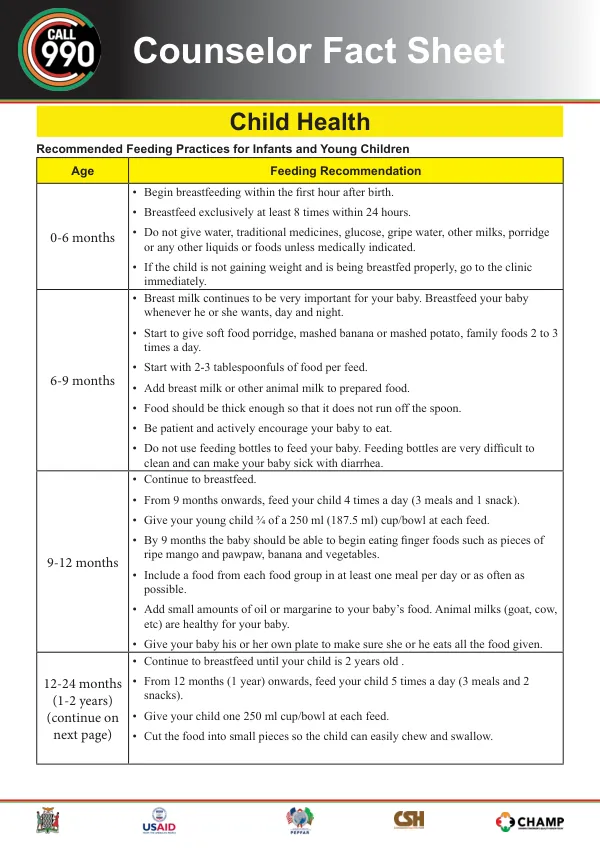
Exclusive breastfeeding is advised for infants from 0-6 months, with a minimum of 8 feedings within 24 hours. Breast milk is essential for the child's growth and development, and it also helps to delay a new pregnancy, protect the mother's health, and reduce the risk of ovarian and breast cancer. As the child grows, solid foods can be introduced at 6-9 months, starting with soft foods such as mashed banana or mashed potato, and gradually increasing the variety and amount of food. By 9-12 months, the child should be able to eat finger foods, such as pieces of ripe mango and pawpaw, banana, and vegetables. It is essential to include a food from each food group in at least one meal per day and to add small amounts of oil or margarine to the child's food. Breastfeeding should continue until the child is 2 years old, and the child should be fed from family meals at least three times a day. Between family meals, the child should be given fruit, such as banana, orange, mango, pawpaw, and guava, and other foods such as samp, sweet potato, bread, rice with sugar or oil, eggs, or beans. The portion size should be increased with the age of the child. The benefits of breastfeeding include helping mother-child bonding and development, delaying a new pregnancy, protecting the mother's health, and reducing the risk of ovarian and breast cancer. Breast milk is easily digested by the baby and provides perfect nutrients to the child. It also protects the baby against infection and helps the uterus to return to its previous size. In addition to breastfeeding, it is essential to provide a safe and healthy environment for the child. This includes keeping the baby warm, drying the baby with a clean dry cloth immediately after birth, and ensuring that the baby is in skin-to-skin contact with the mother. The umbilical cord should only be cut with a new, unused razor and tied with a clean tie, and the cord should be cleaned with a clean cloth and clean, boiled, cooled water. Newborns require special care, and it is essential to recognize the danger signs in a baby after delivery. These include breathing difficulties, fever, chills, fits, rash, yellowness of the skin or eyes, poor sucking or feeding problems, vomiting, not being active, diarrhea or constipation, red, swollen eyes, and redness, pus, or blood from the umbilical stump. Family planning is also essential for the health and well-being of both the mother and the child. It gives a mother's body time to recover between births, allowing her to be stronger and healthier. Babies can breastfeed longer, which helps them to be stronger and healthier. Family planning removes the fear of having an unplanned pregnancy and allows couples to plan how many children they can provide for. The recommended schedule for childhood immunization in Zambia includes the following vaccines: BCG, Polio (OPV-0), Polio (OPV-1,2,3), DPT-HepB-Hib (DPT-HepB-Hib-1,2,3), Rotavirus vaccine, and Measles = OPV-4 if OPV-0 was missed. The minimum age at first dose, number of doses, and minimum interval between doses for each vaccine are specified in the schedule. When counseling a caller dealing with abuse, it is essential to help them go through the following steps: telling their story, believing it happened, believing the abuse was not their fault, dealing with and processing their anger, understanding how the abuse affected their lives, grieving their losses, and correcting dysfunctional behaviors stemming from the abuse. The counselor should respond with empathy and understanding, acknowledging the caller's discomfort and offering to transfer the call to another counselor if necessary. Gender-based violence is against the law, and anyone who witnesses violence has an obligation to report the matter to the relevant authorities. The counselor should be aware of the situation and respond accordingly, suggesting a response for each situation, such as not giving out personal information, acknowledging the caller's discomfort, and offering to transfer the call to another counselor.