USAID DEC
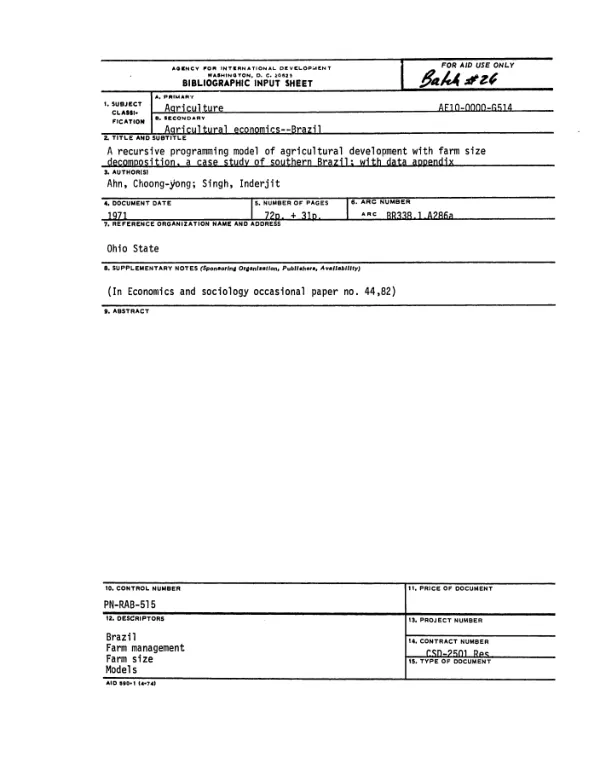
Recursive programming model of regional agricultural development in southern Brazil (1969-1970) : an application of farm size decomposition
Sign inOHIO STATE UNIVERSITY
Recursive programming model of regional agricultural development in southern Brazil (1969-1970) : an application of farm size decomposition
The recursive programming model used simulated the regional economic history for the decade of the sixties.
Ahn, Choong Y. · 1970
Sign in to readA free account is required to download.
Abstract
This simulation generated patterns of resource use including technological change, factor productivities, factor proportions and income distribution by farm size. The model results were validated with the partial historical data available. As a result, the following general conclusions were drawn: (1) from the methodological point of view, the intra-farm differences in various activity decisions in the model support the contention that the decomposition principle has important economic implications in capturing different dynamic paths of development and intra-farm competition for regional resources that would have been totally subsumed otherwise; (2) differences in farm size and hence varying on-farm resource endowments is one of the most important factors in explaining differences in cropping patterns, on-farm labor employment, capital utilization, adoption of technologies, factor productivities, and income distribution; and (3) in general, whereas the output pricing policy provided the incentive for the regional transition, the subsidized credit program provided the means for it. However, these policy instruments appear to have intensified differences between small and large farms by favoring large farms.
Related documents
Documents in this collection
 1970
1970USAID DEC
RECURSIVE PROGRAMMING MODEL OF AGRICULTURAL DEVELOPMENT WITH FARM SIZE DECOMPOSITION, A CASE STUDY OF SOUTHERN BRAZIL; WITH DATA APPENDIX
Open record 1970
1970USAID DEC