FOOD AND AGRICULTURAL ORGANIZATION
Reduced-Impact Logging to improve forest practices and reduce carbon emissions
Reduced-impact logging (RIL) is a forestry practice that aims to minimize the environmental impact and waste associated with conventional logging methods.
2013 · 2 pages
Sign in to readA free account is required to download.
Abstract
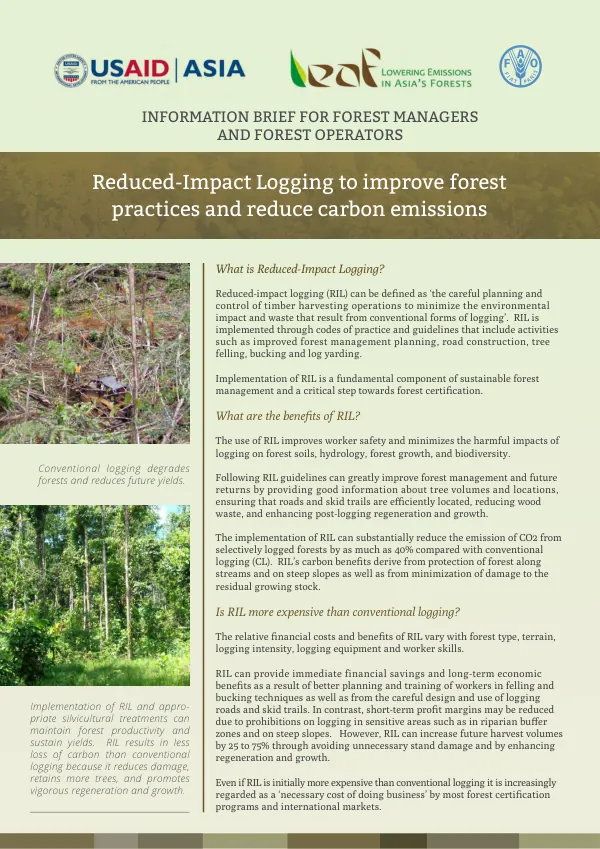
RIL involves careful planning and control of timber harvesting operations, including improved forest management planning, road construction, tree felling, bucking, and log yarding. This approach is a fundamental component of sustainable forest management and a critical step towards forest certification. The benefits of RIL include improved worker safety, reduced harmful impacts on forest soils, hydrology, forest growth, and biodiversity. RIL also provides good information about tree volumes and locations, ensures efficient road and skid trail placement, reduces wood waste, and enhances post-logging regeneration and growth. Furthermore, RIL can substantially reduce the emission of CO2 from selectively logged forests by as much as 40% compared with conventional logging. This reduction in CO2 emissions is attributed to the protection of forest along streams and on steep slopes, as well as the minimization of damage to the residual growing stock. The relative financial costs and benefits of RIL vary with forest type, terrain, logging intensity, logging equipment, and worker skills. While RIL may be initially more expensive than conventional logging, it can provide immediate financial savings and long-term economic benefits through better planning and training of workers, as well as the careful design and use of logging roads and skid trails. RIL can also increase future harvest volumes by 25 to 75% through avoiding unnecessary stand damage and enhancing regeneration and growth. RIL results in less loss of carbon than conventional logging because it reduces damage, retains more trees, and promotes vigorous regeneration and growth. In contrast, conventional logging degrades forests and reduces future yields. Excessively cleared and poorly constructed roads and bridges have major impacts on environmental values and often fail, causing disruption to haulage systems and necessitating high maintenance and repair costs. Poor felling techniques result in excessive waste and damage to logs, lower timber yields, the release of more carbon, and higher risk of injury to fellers. Mechanisms for carbon accounting under REDD+ are most likely to apply at the national or regional scale, with monitoring systems based on combinations of remote sensing and field data. Individual forest management units may be able to get carbon credits by implementing RIL as part of emerging carbon trading markets. Standard forest inventory methods can be used to estimate forest carbon stocks and to monitor the losses and gains from harvesting and post-logging regeneration. Several organizations provide further information about the benefits of RIL and its role in improving forest practices and reducing carbon emissions. These include the Food and Agriculture Organization (FAO), the International Tropical Timber Organization (ITTO), the Tropical Forest Foundation, and the International Conference Proceedings from Kuching, Malaysia in 2001. Additionally, research papers such as "Reduced-impact logging: Challenges and opportunities" by Putz, Sist, Frederickson, and Dykstra (2008) and the report from the May 2012 Asia-Pacific Workshop in Kota Kinabalu, Malaysia, offer valuable insights into the challenges and opportunities associated with RIL.