USAID DEC
Regional Afghan Municipalities Program for Urban Populations: RAMP UP Option Year 1 (Year 2) Work Plan
Sign inDEVELOPMENT ALTERNATIVES, INC./FINNET
Regional Afghan Municipalities Program for Urban Populations: RAMP UP Option Year 1 (Year 2) Work Plan
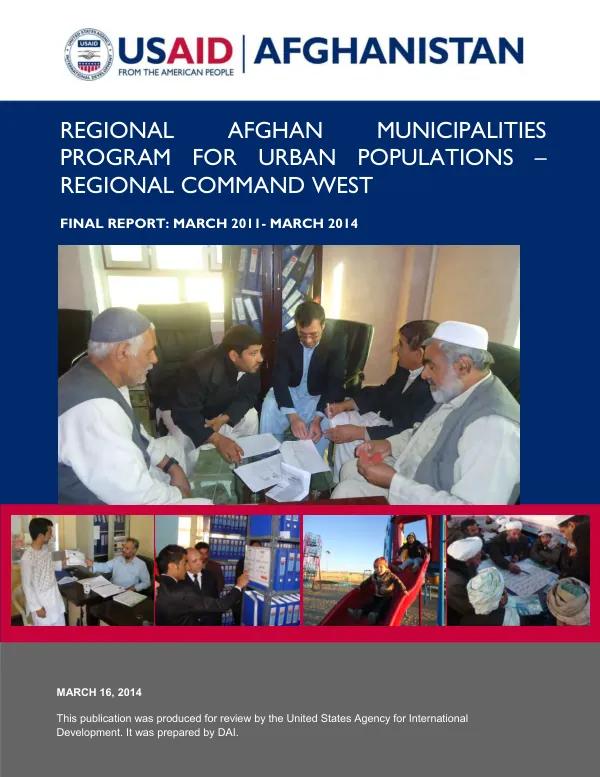
The Regional Afghan Municipalities Program for Urban Populations, Regional Command West (RU-W) was established to create effective, responsive, democratic, transparent, and accountable municipal governance in the four provinces that comprise the International Security Assistance Force's (ISAF's) Regional Command West.
2011 · 24 pages
Sign in to readA free account is required to download.
Abstract
The program's primary objective is to strengthen municipal governance and improve service delivery in urban areas. RU-W began setting up operations in late March 2011, with the hiring of staff and planning of activities. By the beginning of June, USAID had approved the initial project workplan, Performance Management Plan (PMP), and Public Relations and Outreach Strategy. However, as it became clearer that a budget reduction would occur, RU-W moved to curtail staff hiring and reduce program activities. The original concept called for work in the lead provincial municipality and various district municipalities chosen based on identified criteria. However, due to the budget reduction, RU-W limited project activities to only the four provincial capital municipalities. Offices were opened in each municipality, with embedded advisors working directly with municipal counterparts. The program also adjusted its staffing approach, relying more on Afghan local staff and less on expatriate staff. Expatriate technical advisors would concentrate on project design and mentoring the local staff on actual implementation of those designs. RU-W's technical approach focuses on improving municipal governance and service delivery in urban areas. The program's key interventions include the development of municipal improvement plans, implementation of expeditious service delivery projects, and core skills training for municipal staff. The program also aims to strengthen the capacity of municipal governments to deliver essential services, such as solid waste management, water supply, and sanitation. The program's progress to date has been marked by challenges and uncertainties. The initial mobilization of the program was delayed due to the issuance of Presidential Decree 62, which led to uncertainty in the operating environment for international development organizations. However, the program has since made significant progress in setting up operations, hiring staff, and planning activities. Despite the budget reduction, RU-W has adjusted its approach to focus on key interventions and has made significant strides in improving municipal governance and service delivery in urban areas. The program's legislative framework is guided by the Afghanistan National Development Strategy (ANDS) and the Afghanistan Urban Water and Sanitation Corporation (AUWSC) regulations. The program also works closely with the Independent Directorate of Local Governance (IDLG) and the Ministry of Urban Development Affairs (MUDA) to ensure alignment with national policies and regulations. RU-W's implementation plan is focused on achieving key outcomes and impacts, including improved municipal governance, enhanced service delivery, and increased citizen participation. The program's monitoring and evaluation framework is designed to track progress against these outcomes and impacts, and to identify areas for improvement.