USAID DEC
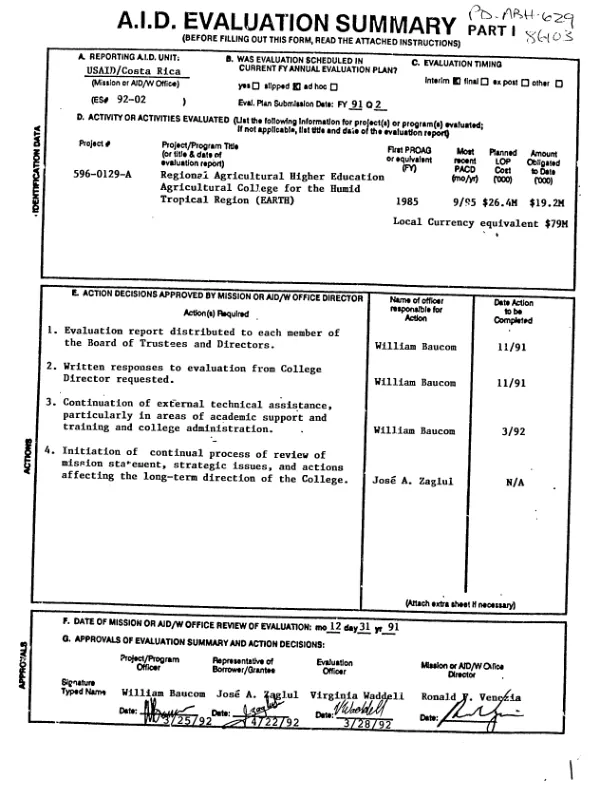
Regional agricultural higher education : Agricultural College for the Humid Tropical Region (EARTH)
Sign inUSAID. MISSION TO COSTA RICA
Regional agricultural higher education : Agricultural College for the Humid Tropical Region (EARTH)
Summarizes interim evaluation (PD-ABD-444) of a project to establish a specialized, 4-year international agricultural college -- the Agricultural College of the Humid Tropical Region (EARTH) -- to prepare professionals to work in the humid tropics of the Americas.
1992
Sign in to readA free account is required to download.
Abstract
The project was approved in 1985 and the institution gained legal status in 1986. During the pre-start-up period, land was acquired for the campus, construction was planned and initiated, key personnel were hired, implementation of the academic program was planned, and administrative policies were drafted. An educational philosophy termed "learning by doing" was refined and incorporated into several aspects of the design and planning of the institution. EARTH began classes in March 1990. The team of three evaluators who visited the project in July 1991 chose to use a "strategic" rather than a "results" oriented approach in their review, examining the logic of the institution through dialogue with directors, staff, faculty and students. Areas of inquiry centered around an examination of the central purpose of the institution, the effectiveness of the processes now in place and the financial sustainability of the College. The team concluded that after a puzzling and long gestation period, the progress of the development of EARTH since its formal opening has been outstanding, by any measure of comparison. The review revealed the university to be in a vitally important phase of transition, one in which the locus of control is shifting from groups of people who are essentially outside the institution to those who comprise the institution. The evaluators found evidence of confusion and stress at EARTH, which is understandable considering that there are new faculty, administrators, staff, and students being incorporated into the institution constantly. A product of this transition is uncertainty about the central purpose of the institution, and about some of the processes that are being used as the institution learns how to operate. On the financial side, EARTH has significant capital resources; however, they appear insufficient to guarantee its future financial viability. A focused review of progress to date and specific recommendations are not included in the evaluation, however, except in the evaluation of financial viability. These include: (1) the need for integration of financial strategies with overall strategic planning; and (2) the need for integration of EARTH fundraising strategies with the intentions and capacities of its directors and trustees. (Author abstract)