USAID. MISSION TO JAMAICA
Agricultural education
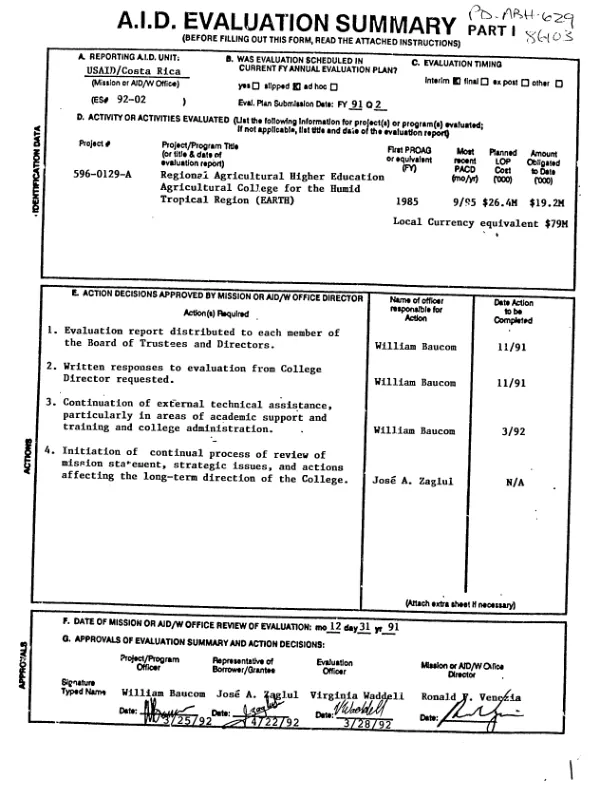
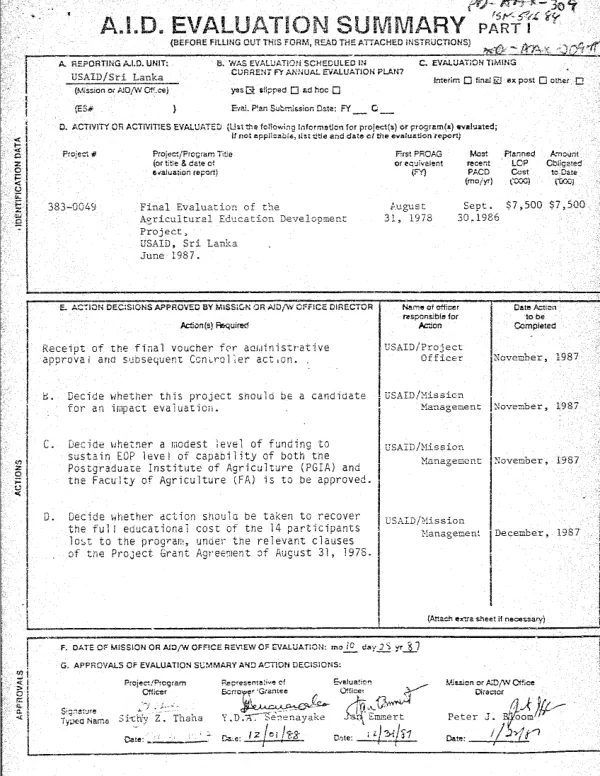
Summarizes attached interim evaluation (XD-AAY-956-A) of a project to improve agricultural education in Jamaica by providing management and research TA to the recently established College of Agriculture (COA) and the Knockalva Agricultural School (KAS).
1989
Sign in to readA free account is required to download.
Abstract
The evaluation covers the period 8/84-FY88. The project has contributed significantly to the development of KAS and COA, which are vital to Jamaica"s economic and agricultural development. KAS is financially sound and well administered, its faculty are competent and dedicated, and its students are of strong capability, morale, and ambition. The COA, a younger institution, still falls short in most of these respects. TA provided to COA by the Louisiana State University Agricultural Consortium (LSUAC) has been of superior quality and quantity, but greater efforts are needed to fully utilize the considerable amount of policy, procedural, technical, and informational manuals and documents provided. Similarly, there has been a lag in construction, participant training, and applied research. Extension/outreach activities and curriculum development have proceeded at a faster pace than other components, but there is a need to improve their quality and their relation to Jamaican institutions. Nevertheless, there now appears to be momentum in all project aspects, albeit stronger in some than in others. Three problem areas require the urgent attention of LSUAC, USAID/J, and the Ministry of Education: (1) the COA"s severe financial crisis; (2) problems in communication and working relationships among and within the cooperating parties caused by deficient operating principles and systems; and (3) inconsistent curriculum, graduate certification, and qualifications for advanced education among the agricultural schools, the COA, and the University of the West Indies. Certification problems affect employment of graduates, student and faculty morale, relationships of the present institutions within Jamaican politics and society, project progress, and the COA"s long-term viability. It is recommended that the project be extended at least one year and a follow-on project be considered. Several lessons were learned. (1) Host governments need to understand that agricultural education may require more resources than education in other fields. (2) Short-term outputs must be sacrificed occasionally in order to achieve long-term institution-building objectives. (3) The sociological context within which a project is conducted must be understood and accommodated in order to successfully reach project goals. (4) When starting a new institution, an effort to incorporate elements of its predecessors may be needed in order for the new institution to legitimize itself.