USAID DEC
Regional and National Capacity Development for Hazard Monitoring, Early Warning and Decision Support
Sign inUNIVERSITY OF HAWAII
Regional and National Capacity Development for Hazard Monitoring, Early Warning and Decision Support
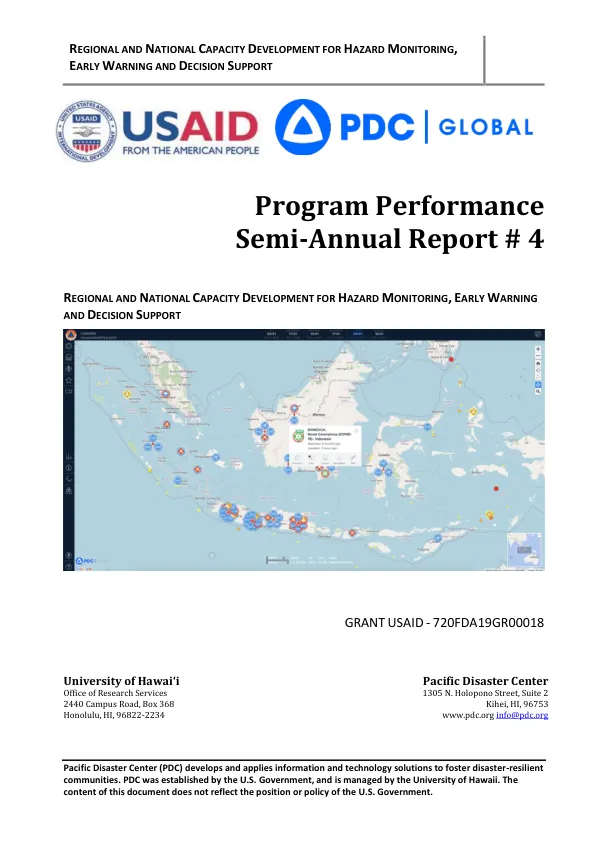
Regional and National Capacity Development for Hazard Monitoring, Early Warning, and Decision Support is a project aimed at enhancing the capacity of regional and national disaster management organizations to monitor, warn, and support decision-making in the face of natural hazards.
2021 · 10 pages
Sign in to readA free account is required to download.
Abstract
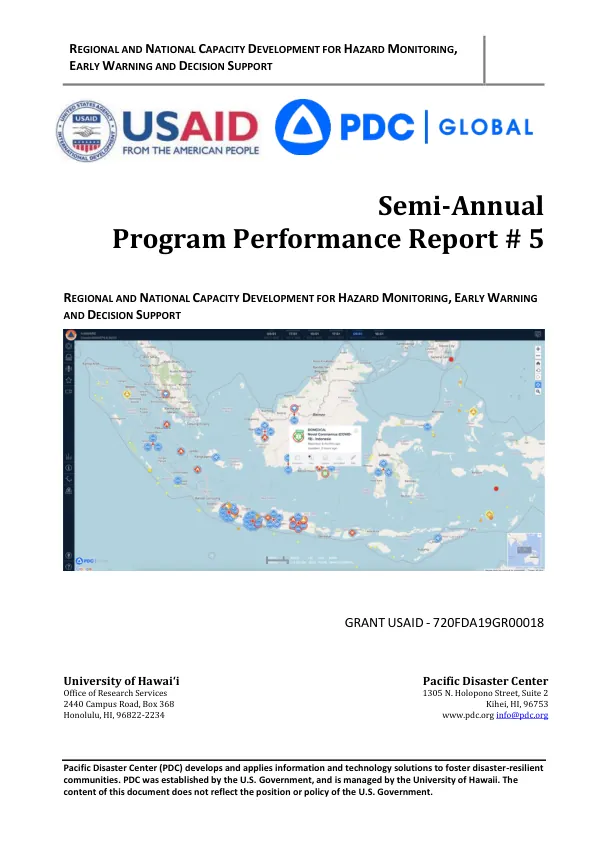
The project is funded by the United States Agency for International Development (USAID) under grant 720FDA19GR00018. The project is implemented by the Pacific Disaster Center (PDC), a non-profit organization established by the U.S. Government, in partnership with the University of Hawaii. The project's primary objective is to develop and apply information and technology solutions to foster disaster-resilient communities. During the reporting period of April 1, 2021, to September 30, 2021, the project team continued to engage with regional and national disaster management organizations to advance outstanding project activities. Despite the ongoing COVID-19 pandemic, the project team was able to complete all major technical tasks, including the enhancement of the Disaster Monitoring and Response System (DMRS). The DMRS system enhancement involved the addition of an account request form to the DMRS launch page, configuration of a DMRS user statistics tracking application, and the update of the DMRS Command Post from version 24.9 to 26.0. Additionally, the SSL certificate was renewed and configured, system email templates were updated, and identified bugs were fixed. The project also focused on regional capacity development, including user training, system administration training, and DMRS eLearning. On July 27, DMRS user training was delivered to 11 AMS NDMO representatives, while system administration training was conducted for five AHA Centre staff on June 16 and virtual DMRS data processing and configuration training was provided to five AHA Centre participants on August 11. Monitoring and evaluation activities were also conducted during the reporting period. Additional in-kind contributions from the AHA Centre and government counterparts brought the total for the project to US$218,000. Event monitoring indicated that project events were accessible, and participants felt included. Skills review tests undertaken by user training participants resulted in a 100 percent pass rate. In Indonesia, project activities were limited due to the ongoing COVID-19 pandemic, but all outstanding technical tasks were completed. Coordination meetings were held with senior BNPB staff to advance outstanding project activities, including an InAWARE use evaluation briefing and a presentation of InAWARE at the National EOC coordination meeting. The project's accomplishments during the reporting period include the completion of all major technical tasks, the enhancement of the DMRS system, and the delivery of user training and system administration training to regional and national disaster management organizations. The project's continued engagement with regional and national disaster management organizations has helped to advance the capacity of these organizations to monitor, warn, and support decision-making in the face of natural hazards.