USAID DEC
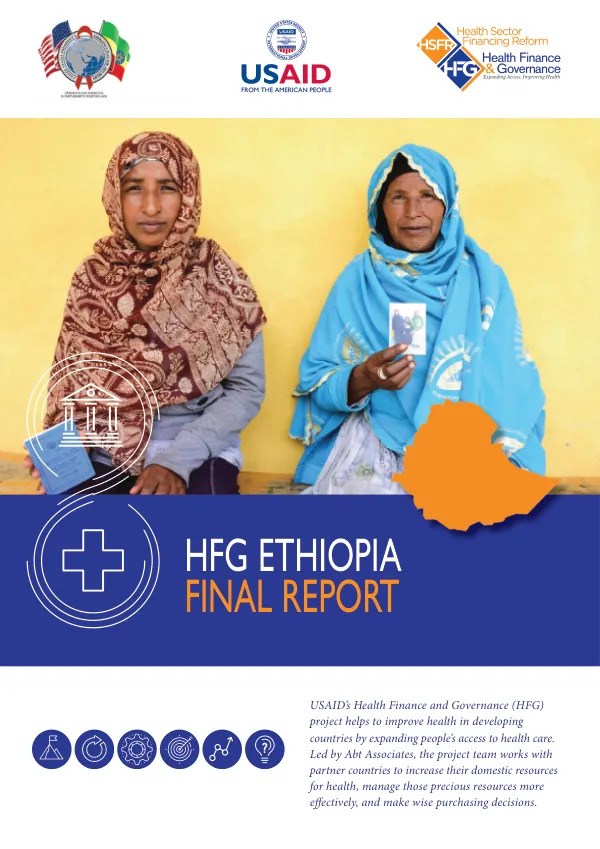
Regional Brief: Health Sector Financing Reform/Health Finance and Governance (HSFR/HFG) Project in Tigray, Ethiopia
Sign inETHIOPIAN HEALTH INSURANCE AGENCY
Regional Brief: Health Sector Financing Reform/Health Finance and Governance (HSFR/HFG) Project in Tigray, Ethiopia
The USAID-funded HSFR/HFG project provides technical assistance to the Government of Ethiopia to implement and scale-up health care financing reforms across the country.
2018 · 8 pages
Sign in to readA free account is required to download.
Abstract
The goal is to increase access to and utilization of health services through improved quality of health care and reduced financial barriers. Project objectives include improving the quality of health services, improving access to health services, improving governance of health insurance and health services, and improving program learning. Tigray is the northernmost of Ethiopia's nine regions, divided into seven administrative zones and 52 woredas. The region has a population of approximately 5.2 million people, the majority of whom are farmers. Over the past 30 years, various regional government initiatives have significantly improved access to health services, with the addition of hospitals and health centers throughout the region and construction of health posts in each kebele. Today, there are 712 health posts, 204 health centers, 22 primary hospitals, 14 general hospitals, and one specialized hospital in Tigray. The health care system in Tigray has faced many challenges related to financing, including limited financial resources, difficulties in managing financial resources, inefficient and inequitable use of health resources, and poor health service quality. To address these challenges, the Tigray regional government implemented the Federal Ministry of Health's health care financing reform initiatives and put in place the required legal frameworks to guide implementation of the reforms. The HSFR/HFG project has since 2013 provided technical support to the regional health bureau, Ethiopian Health Insurance Agency branch offices, woreda administrations, woreda health offices, community-based health insurance schemes, and health facilities in the design, legislation, implementation, and evidence generation of these reforms. The Ministry of Health's health facility governance reform allows for increased health facility autonomy through the establishment of governing bodies at health facilities to contribute to the proper and timely use of facility resources and respond to client needs. The HSFR/HFG project supported regional government efforts to implement governance reform, including advocating to all relevant stakeholders on the importance of governing bodies, supporting the RHB in putting in place the required guidelines for the establishment and operation of health facility governing bodies, and providing training in the objectives, implementation procedures, and monitoring and review mechanisms of the reform. Mekelle Health Center is one of many health facilities in the region that have benefited from having a fully functional management committee, the governing body of the facility. The management committee provides proper leadership to the implementation of various government reforms, including health care financing reforms. Informed decisions taken by the health center's management committee to use internal revenue have improved service delivery, which in turn has increased patient flow and mobilized still more revenue at the facility every year for the past five years. The health center's retained revenue increased from 0.85 million birr in 2013/14 to 1.4 million birr in just the first three quarters of 2017/18. Since HSFR/HFG began in 2013, the number of health facilities with functional governing bodies has increased from 12 to 36 boards in hospitals and 108 to 204 management committees in health centers. Equally important, board and committee capacity to govern and oversee health care financing reform implementation has improved. Through HSFR/HFG support, health facilities now have functional governing bodies in place that are capable of making informed decisions about mobilizing and allocating resources at their facilities, as well as developing and administering facility budgets. HSFR/HFG collaborated with the RHB to train 1,603 board members. Although there are differences in their levels of performance, governing bodies in Tigray are able to advocate to regional and woreda administrations for the allocation of more resources from the government and non-governmental organizations to health facilities, mobilize resources from the community, and prioritize the use of available resources according to need. The number of health facilities implementing revenue retention and utilization (RRU) increased from 120 at the beginning of HSFR/HFG in 2014 to 240 in 2018. All health facilities in Tigray are now implementing this reform, although there are differences in the magnitude of resources mobilized (retained) and in their utilization. Figure 2 shows the total amount of birr retained and utilized by health facilities in the region over the last four years. In 2013/14, for example, over 88.5 million birr were retained and 93.6 million birr utilized; in 2016/17, 142.3 million birr was retained and 201.5 million birr utilized. This represents a more than 1.6 times the amount of revenue collected and more than doubling of the amount utilized over three years. The amount of money utilized exceeds the retained revenue for each year.
![A survey of water conservation knowledge, attitude and practices of 35 mayors in Northen Jordan [Arabic]](https://covers.devme.ai/gen/151184.webp)